
By Sandra Tanner

thou shalt be called a seer, a translator, . . . of Jesus Christ
(Doctrine and Covenants 21:1)
On April 6, 1830, the day Joseph Smith founded the Church of Christ, later renamed The Church of Jesus Christ of Latter-day Saints, he received a revelation designating himself as “a seer, a translator, a prophet, an apostle.” The terms prophet and apostle are generally understood in LDS circles. But what is meant by seer and translator? Does divine translation result in the same message that scholars, taking a specific text from one language and rendering it in another, would arrive at? If not, how are we to understand “translate” in Smith’s writings?
Traditionally the LDS Church has taught that the Book of Mormon is a literal translation of an actual record, inscribed on gold plates, recounting God’s dealings with the people occupying America hundreds of years before the arrival of the Europeans. However, extensive research shows the presence of nineteenth-century ideas and sources, such as the King James Version (KJV) of the Bible, in the book.1 This is causing some LDS scholars to redefine the word translation to mean revealed text. For example, Richard Bushman, author of Joseph Smith: Rough Stone Rolling, responded in an interview:
“The Book of Mormon is a problem right now. It’s so baffling to so many that Joseph was not even looking at the gold plates [to translate them]. And there’s so much in the Book of Mormon that comes out of the 19th century that there’s a question of whether or not the text is an exact transcription of Nephi’s and Mormon’s words, or if it has been reshaped by inspiration to be more suitable for us, a kind of an expansion or elucidation of the Nephite record for our times. I have no idea how that might have worked or whether that’s true. But there are just too many scholars now, faithful church scholars, who find 19th-century material in that text. That remains a little bit of a mystery, just how it came to be.”2
Years of research have led to several theories of how Joseph Smith produced his scriptures. These can be broadly put into four categories:
- The literal translation, or “tight control,” theory, where Smith dictated the English text he read on his seer stone, which in turn was the Lord’s translation of what was recorded on the ancient plates.3
- The expanded text theory, where Smith expanded the message of the ancient record with current concepts and Bible quotes.4
- The revelatory theory, where the dictated text is more the result of inspiration, meditation, and influences of the day than actually translating an ancient record into English, sometimes referred to as the catalyst theory.5
- The naturalistic (fiction) theory, where no ancient text is needed, only the creative mind of the storyteller coupled with religious issues of the day and current events.6
These theories would help explain why Smith never looked at the ancient plates during his dictation. However, only the first theory fits the earliest accounts of Smith’s translation efforts, with Smith simply reading the God-given English translation off his seer stone to scribes. In recent speeches and articles the top leadership of the LDS Church seem to be holding to the literal method while many of its scholars seem to be looking more to an expanded text or the revelatory theory.7

Joseph Smith dictating the Book of Mormon from his seer stone, placed within a hat.
Book of Mormon Translation Essay
In 2013 the LDS Church released several essays addressing difficult issues in their history.8 One of these articles, “The Book of Mormon Translation,” discusses the method used by Joseph Smith to render the Book of Mormon into English.9 In this article we read, “The angel charged Joseph Smith to translate the book from the ancient language in which it was written.” Thus Smith is declared to be in possession of an actual record that is translatable.
The article then proceeds to build a case of Smith as an uneducated man incapable of inventing such a complicated story, thereby implying that it must be what it claims to be, a God-given translation from an ancient text. The article asserts that Smith was untrained in languages; thus the translation was accomplished through the use of divinely prepared instruments called “interpreters” (large spectacles with crystal lenses preserved with the plates) and “seer stones” (magic rocks found in the ground by Joseph Smith).
We read further that “by looking through these, he was able to read in English, the reformed Egyptian characters, which were engraven on the plates.” This claim of dictating the English text as it appeared on the interpreters or stone would certainly demand a God-given translation from one language to another, which would preclude Smith expanding the text.
To emphasize the book’s historicity and underscore Smith’s limited education and inability to compose such a book, the essay quotes Emma Smith, Joseph’s wife, saying that he “could neither write nor dictate a coherent and well-worded letter, let alone dictate a book like the Book of Mormon.” However, the inaccuracy of this statement is seen when we examine one of Smith’s letters written in 1829:
Respected sir I would in form you that I arrived at home on sunday morning the 4th. after having a prosperous journy, and found all well the people are all friendly to <us > except a few who are in opposition to evry thing unless it is something that is axactly like themselves and two of our most formadable persacutors are now under censure and are cited to a
tryaltrial in the church for crimes which if true are worse than all the Gold Book business. we do not rejoice in the affliction of our enimies but we shall be glad to have truth prevail[.] there begins to be a great call for our books in this country the minds of the people are very much excited when they find that there is a copy right obtained and that there is really books about to be printed.10
While there are several misspelled words, the document demonstrates that Joseph Smith could write a “coherent and well-worded letter,” thus showing that Emma was simply trying to bolster the idea that Joseph was too uneducated to have composed the Book of Mormon. Also, Joseph himself wrote in 1832 that he studied the Bible from the age of 12,11 and his mother said he entertained the family in the evenings with stories of the Native Americans.12 Young Joseph, according to Orsamus Turner, attended the local Methodist camp meetings, becoming a “very passible exhorter at evening meetings.” Turner also recalled that Joseph was involved in the “juvenile debating club.”13 These activities show he had an active mind, was a reader, and could compose his thoughts. In addition, one only needs to look at his revelations during and after writing the Book of Mormon to see his ability to dictate his thoughts to a scribe.14
In the Beginning
Joseph Smith spent his teen years in western New York, in an area often referred to as the burnt-over district, well-known for numerous religious revivals and spiritual excitement. While his parents were religious, they were not members of any particular church. However, during an 1824–25 revival in Palmyra, New York, Joseph’s mother, sister, and two brothers joined the Presbyterian Church. His father, Joseph Smith Sr., refused to affiliate with any denomination and only attended one or two of the local revival meetings. Joseph Jr. studied the Bible from the age of twelve, attended the revivals often, and evidently favored the Methodists.15
In the 1820s many people, including the Smiths, believed in magical stones, like crystal balls, and divining rods that allowed the owner to discover the location of buried treasures, metal, or water. For instance, the Wayne Sentinel, published in Joseph Smith’s neighborhood, reprinted the following from the Windsor (Vermont) Journal:
Money digging —We are sorry to observe even in this enlightened age, so prevalent a disposition to credit the accounts of the Marvellous. Even the frightful stories of money being hid under the surface of the earth, and enchanted by the Devil or Robert Kidd, are received by many of our respectable fellow citizens as truths. . . . A respectable gentleman in Tunbridge, was informed by means of a dream, that a chest of money was buried on a small island. . . . After having been directed by the mineral rod where to search for the money . . . he and his laborers came . . . upon a chest of gold . . . the chest moved off through the mud, and has not been seen or heard of since.16

Wayne Sentinel, 1825 February 16, p. 1, column 5
(click to view)
Oliver Cowdery, who acted as scribe for Smith during most of the Book of Mormon dictation, evidently claimed the gift of working with a divining rod. In the 1833 Book of Commandments, section seven, his gift is called “the gift of working with the rod” and “rod of nature” which works “in your hands, for it is the work of God.” But this section was rewritten for the 1835 edition of the Doctrine and Covenants, now section eight, changing Cowdery’s “rod of nature” to “gift of Aaron,” which you hold “in your hands.” These changes obscure the original meaning of Cowdery’s practice of dowsing, using a magical divining rod.


Dowsing with a rod
Another story in the 1825 Wayne Sentinel told of people using a “mineral stone” placed in a hat to locate buried treasures, similar to Joseph Smith’s efforts:
Wonderful Discovery.—A few days since was discovered in this town, by the help of a mineral stone, (which becomes transparent when placed in a hat and the light excluded by the face of him who looks into it, provided he is fortune’s favorite,) a monstrous potash kettle in the bowels of old mother Earth, filled with the purest bullion. . . . His Satanic Majesty, or some other invisible agent, appears to keep it [the treasure] under marching orders; for no sooner is it dug on to in one place, than it moves off like “false delusive hope,” to another still more remote.17

Wayne Sentinel, 1825 December 27, p. 2, column 4
(click to view)
Interestingly, a similar story of burying riches only to find that the treasure has slipped away is found in the Book of Mormon. There Samuel the Lamanite speaks of “slippery” treasure:
“And behold,” he said, “the time cometh that he curseth your riches, that they become slippery, that ye cannot hold them; and in the days of your poverty ye cannot retain them.
“. . . And then shall ye lament, and say: . . . O that we had remembered the Lord our God in the day that he gave us our riches, and then they would not have become slippery that we should lose them; for behold, our riches are gone from us.
“. . . Yea, we have hid up our treasures and they have slipped away from us, because of the curse of the land.”
(Helaman 13:31–33, 35)
These are just a few of the instances where the Book of Mormon story mirrors events in Smith’s environment. Joseph Smith and most of the early converts to Mormonism believed in such magical instruments as seer stones and mineral rods.18
In 1822 Joseph Smith found a magic rock, like the one mentioned in the Wayne Sentinel, while digging a well for his neighbor, Willard Chase. In 1833 Mr. Chase gave his account of the event:
“I became acquainted with the Smith family, known as the authors of the Mormon Bible, in the year 1820. At that time, they were engaged in the money digging business, which they followed until the latter part of the season of 1827. In the year 1822, I was engaged in digging a well. I employed Alvin and Joseph Smith to assist me; the latter of whom is now known as the Mormon prophet. After digging about twenty feet below the surface of the earth, we discovered a singularly appearing stone, which excited my curiosity. I brought it to the top of the well, and as we were examining it, Joseph put it into his hat, and then his face into the top of his hat. . . . After obtaining the stone, he began to publish abroad what wonders he could discover by looking in it, . . .”19
The LDS essay acknowledges that Joseph Smith used his stone for money-digging. It also acknowledges that the rock was used for translating the Book of Mormon because it proved to be more convenient than the sacred interpreters preserved with the plates. According to the essay:
As a young man during the 1820’s, Joseph Smith, like others in his day, used a seer stone to look for lost objects and buried treasure. As Joseph grew to understand his prophetic calling, he learned that he could use this stone for the higher purpose of translating scripture. Apparently for convenience, Joseph often translated with the single seer stone rather than the two stones bound together to form the interpreters.
While the LDS essay concedes Smith’s use of his magic rock in looking for buried treasures, the brief mention hardly covers the situation. The Smith family was very involved in folk magic in the early 1800s. Joseph’s stone found in 1822 reportedly possessed special powers and he had used it for years to inform people where to look for hidden or lost items. In an interview Martin Harris discussed some of the Smiths’ involvement in searching for buried riches, naming
Joseph Smith, jr., and his father, and his brother Hiram Smith. They dug for money in Palmyra, Manchester, also in Pennsylvania, and other places. When Joseph found this stone, there was a company digging in Harmony, Pa., and they took Joseph to look in the stone for them.20
Joseph’s mentor for using a seer stone seems to have been Luman Walters, a well-known magician and con man. Richard Van Wagoner observed: “In the 1820s, these credulous souls believed in the posturings of Luman Walters and other tricksters like him.”21
Besides this, Smith also carried on his person a small magic medallion called a Jupiter Talisman22 and the Smith family also owned several magic parchments and a magic dagger.23


(Left): Both sides of Joseph Smith’s magic talisman.
(Right): A photo of a magic parchment owned by Joseph Smith’s brother, Hyrum.
(click to view)
Then in 1826 Joseph Smith was arrested and charged with a misdemeanor for his claim of being able to locate buried treasures by use of his seer stone. In the court document he was referred to as a “glass-looker.”24 The issue centered on whether or not Joseph was defrauding people by claiming that his seer stone had special powers. Josiah Stowell, who had hired him, testified that Smith did have such powers. Another man, Jonathan Thompson, testified of Smith’s ability and that when they had dug for the buried trunk they hit something hard, like a plank, “the board which he struck his spade upon was probably the chest, but on account of an enchantment the trunk kept settling away from under them when digging; that notwithstanding they continued constantly removing the dirt, yet the trunk kept about the same distance from them.”25
Joseph’s defense at the 1826 hearing was that he had a genuine gift of using his seer stone and had done so for at least three years, but “of late had pretty much given it up on account of its injuring his health, especially his eyes, made them sore” (Walters, Joseph Smith’s Bainbridge, N.Y., Court Trials, p. 149).

(From Utah Lighthouse Ministry photo of page xx in The Joseph Smith Papers: Revelations and Translations, Volume 3, Part 1: Printers Manuscript of the Book of Mormon, 1 Nephi 1—Alma 35)
Regardless of the outcome of the hearing, the issue still remains: did the rock have magical properties that only a “seer” could use? If one accepts Smith’s claim of seeing in his stone the translation of the Book of Mormon, then it follows that his claim to see the location of treasures with the same stone would be valid as well. Yet no treasures were ever located.
Called to Translate
According to Smith’s story at the back of the Pearl of Great Price26 in 1823 a heavenly being appeared in his bedroom to announce that God had called him to translate the long-lost record of the former inhabitants of the American continent, recorded in an unknown language called Reformed Egyptian and engraved on gold plates. These plates, according to Smith’s story, had been buried in 421 AD by Moroni, the last man to make an entry on the plates.
However, Joseph was not able to retrieve the record from the local hill where they were buried until 1827. When Joseph was about to receive the plates an angel told him “He must quit the company of the money-diggers. That there were wicked men among them. He must have no more to do with them.”27 Thus we see that during the time Joseph was supposedly being groomed for his calling as “seer” (1823–1827), he was heavily involved in magic, glass-looking, and searching for buried treasures.28
The essay tries to normalize the Smith family’s involvement with magic by pointing out that Joseph’s use of a seer stone was a common practice in the 1820s. However, this is overstating the situation. Yes, others believed in magic stones, but it was not accepted by many of the Christians in the community. In fact, it was the major reason that Joseph was denied membership in the Methodist Church in 1828. When Joseph Lewis, Emma Smith’s cousin, discovered that Joseph’s name had been added to the membership class he “thought it was a disgrace to the church to have a practicing necromancer” as a member. Joseph was told to either repent of his magic activities or withdraw his name. The end result was that his name was dropped from the rolls of the local Methodist church.29 Christians today are also troubled by the Smiths’ involvement with magic in light of such verses as Deuteronomy 18:10–12:
There shall not be found among you . . . anyone who practices divination or tells fortunes or interprets omens, or a sorcerer or a charmer or a medium or a necromancer or one who inquires of the dead, for whoever does these things is an abomination to the Lord.
According to Smith, in 1827 he was finally able to remove the ancient record from the hill and commence his work. The necessity of waiting four years to procure the plates suggests he literally needed them to produce his translation. The manuscript was completed and published in 1830 under the title The Book of Mormon.
Lost 116 Pages
In Joseph Smith’s history he relates that he began translating the plates in 1828 with Martin Harris acting as one of his scribes. Martin’s wife had been badgering him for some time that Smith’s claims were not valid. Harris left home in northwest New York, traveling to Harmony, Pennsylvania, in April to aid Smith in his translation work. At last Martin was able to convince Joseph to let him take a few pages of the manuscript home to Manchester, New York, to show his wife that he was aiding Smith in a genuine work of God. Joseph had been reluctant to oblige, but finally agreed.
When Harris did not return the pages in a timely manner, Smith made the trip to Harris’ home. Smith’s worst fears had been realized—the pages were lost, stolen, or destroyed. Joseph’s mother, Lucy Mack Smith, described the meeting when Harris came to the Smith family home and told Joseph he had lost the pages: “Oh! My God My God My God said Joseph clenching his hands together all is lost is lost what shall I do I have sinned.”30 Soon after this, Joseph received a revelation chastising him for allowing Harris to take the pages home, and the Lord temporarily removed his gift of translating.31
Joseph evidently feared that Martin Harris, referred to as a “wicked man” in Doctrine and Covenants, section 10, was doubting his prophetic claim and planned to put him to the test by altering the words of the manuscript.
In the preface to the 1830 Book of Mormon Joseph Smith explained that even though God could give him the power to translate the same words again, he was to switch to a different set of plates:
As many false reports have been circulated . . . and also many unlawful measures taken by evil designing persons to destroy me, and also the work, I would inform you that I translated, by the gift and power of God, and caused to be written, one hundred and sixteen pages, the which I took from the Book of Lehi, . . . which said account, some person or persons have stolen and kept from me, . . . —and being commanded of the Lord that I should not translate the same over again, for Satan had put it into their hearts to tempt the Lord their God, by altering the words, that they did read contrary from that which I translated and caused to be written; and if I should bring forth the same words again, or, in other words, if I should translate the same over again, they would publish that which they had stolen, and Satan would stir up the hearts of this generation, that they might not receive this work: . . . therefore thou shalt translate from the plates of Nephi, until ye come to that which ye have translated, . . . and thus I will confound those who have altered my words. . . .32
First, we wonder why Joseph couldn’t just look in his stone and find the lost pages or see what happened to them? He had done so at an earlier time. According to Joseph Smith’s mother, when he first took the plates out of the ground he temporarily hid them in the trunk of a tree. While he was away from home, his wife, Emma, went to him to warn him that people were using local mediums to try to locate the hiding place of the plates. But Smith “looked in the Urim and Thummim, and saw that the Record was as yet safe.”33 Second, how could a scoundrel change the words in the manuscript without it showing signs of alteration? Third, it seems obvious that Smith couldn’t retranslate the same words again, so he had to come up with an excuse that would still support his claims of translating. Thus Joseph announced that the Lord had prepared for this event over two thousand years before by telling Nephi to make a second set of records that covered that same time period but included more religious material. Therefore, Smith is told not to translate the same material again but to switch to this other, more religious set of plates.34 This leaves one wondering why God had Joseph start with Nephi’s larger set of plates in the first place. Joseph’s story of two sets of plates sounds more like a way to cover up the fact that he couldn’t dictate the same material again.35
Becoming a Seer
The Book of Mormon presents the idea of a prophetic calling to be a seer, which includes the ability to translate ancient records. In Mosiah 8:9–13, we are told of an ancient record of the Jaredites, a group who migrated to America at the time of the tower of Babel, preserved on twenty-four gold plates, which were written in an unknown script. The king is told of “a man that can translate the records; for he has wherewith that he can look, and translate all records that are of ancient date” (Mosiah 8:13). This gift operates by staring into an apparatus called “interpreters.” Only a seer may look in these sacred objects and receive instruction from God. Several chapters later, we are told that the Jaredite record was translated “by the means of those two stones which were fastened into the two rims of a bow. . . . And they have been kept and preserved by the hand of the Lord . . . And whosoever has these things is called seer” (Mosiah 28:13–16). Notice that the label seer does not stand alone but is given to one who has these special eyeglasses. Smith claimed that these were buried with the Nephite record to aid the future seer who would translate the Book of Mormon plates.36 Joseph Smith described the interpreters as:
two stones in silver bows—and these stones, fastened to a breastplate, constituted what is called the Urim and Thummim—deposited with the plates; and the possession and use of these stones were what constitutes seers in ancient or former times; and that God had prepared them for the purpose of translating the book[Book of Mormon].37

From the book, A New Look At Mormonism, John W. Rich, Fred O. Alseth, illustr., (Sacramento: Fritz n’ Rich Publishers, 2nd ed., 1963), p. 48. Author’s description: A book to help LDS members “explain the Gospel” with interesting illustrations to “hold the attention and the interest of the young people and investigators alike.”
While the interpreters, later referred to as Urim and Thummim, were specifically preserved for use in translating the plates,38 Joseph Smith evidently only used them, if at all, in producing the first 116 pages of the manuscript. After Martin Harris lost those pages, Smith was only seen using his own stone, found several years earlier, to produce the manuscript used in the printing. Emma Smith and two of the Book of Mormon witnesses, Martin Harris and David Whitmer, all described Joseph using his stone in his hat while dictating the Book of Mormon,39 but none of them describe him using the ancient glasses/interpreters buried with the plates. This raises the question: Why were the Book of Mormon interpreters preserved for centuries if Joseph Smith could simply use a rock he found buried on his neighbor’s property?
In 1939, LDS scholar Dr. Francis W. Kirkham denounced the claim that Smith used a seer stone to translate. He wrote in the LDS Church magazine, Improvement Era:
A neighbor, Willard Chase, asserted Joseph stole a “singularly appearing stone” which he had found in 1822 when Joseph and his brother Alvin were employed by him in digging a well. “Joseph put it into his hat and then his face into the top of his hat . . . alleging that he could see in it.”—Mormonism Unveiled, Eber D. Howe, 1834.
This is an attempt to explain the alleged power of Joseph Smith to translate the plates by a person who denounced him as a fraud and an ignorant deceiver.
In the opinion of the writer, the Prophet used no seer stone in translating the Book of Mormon, neither did he translate in the manner described by David Whitmer and Martin Harris.40
However, research has proven Dr. Kirkham wrong. Russell M. Nelson, the current President of the LDS Church, has endorsed the accounts of Smith using a stone in his hat to translate, and even provided a demonstration of it in a recent video.41
Many years ago M. T. Lamb made some important observations regarding Joseph Smith’s use of his stone instead of the Urim and Thummim:
You must understand that the Urim and Thummim spoken of, and called throughout the Book of Mormon “the Interpreters,” had been provided with great care over 2500 years ago by God himself, for the express purpose of translating these plates. They are often mentioned in the Book of Mormon as exceedingly important. They were preserved with the greatest care, handed down from one generation to another with the plates, and buried with them in the hill Cumorah over 1400 years ago; as sacred as the plates themselves. So sacred that only one man was allowed to handle or use them, the highly favored prophet, Joseph Smith himself.
But now, alas! After all this trouble and pains and care on the part of God, and on the part of so many holy men of old, this “Urim and Thummim” is found at last to be altogether superfluous; not needed at all. This “peep stone” found in a neighbor’s well will do the work just as well—and is even more convenient, “for convenience he used the seer stone.” So we are left to infer that when he used the Urim and Thummim at all, it was at some inconvenience.42
A Literal Translation?
As an example of Smith’s claim of a standard work of translation, he wrote “The title-page of the Book of Mormon is a literal translation, taken from the very last leaf, on the left hand side of the collection or book of plates, which contained the record which has been translated, . . .”43
David Whitmer’s description of the translation process sounds very much like looking at an interlinear version of the Bible:44
Joseph Smith would put the seer stone into a hat, and put his face in the hat, drawing it closely around his face to exclude the light; and in the darkness the spiritual light would shine. A piece of something resembling parchment would appear, and on that appeared the writing. One character at a time would appear, and under it was the interpretation in English. Brother Joseph would read off the English to Oliver Cowdery, who was his principal scribe, and when it was written down and repeated to Brother Joseph to see if it was correct, then it would disappear, and another character with the interpretation would appear.45
This process did not involve any use of the original plates. Emma Smith related that the plates were off to the side, “wrapped in a small linen table cloth.”46 The English translation miraculously appeared on the stone and did not require any linguistic ability. Even though the plates were not consulted, Smith always presented his work as an actual translation from an ancient text:
[T]he fact is, that by the power of God I translated the Book of Mormon from hieroglyphics, the knowledge of which was lost to the world, in which wonderful event I stood alone, an unlearned youth, to combat the worldly wisdom and multiplied ignorance of eighteen centuries, with a new revelation, . . .47
Such statements certainly present the project as Smith dictating the English translation of what was literally written on the plates in Reformed Egyptian. Otherwise, why preserve the plates for centuries? God could have revealed the Nephite history to Smith without the record, as he later claimed with the Book of Moses. From this, one would expect that anyone knowledgeable in Reformed Egyptian could have produced a translation essentially the same as Smith’s version.
For example, when LDS scholars produce a new translation of the Book of Mormon, or any other text, from English to another language, the same essential message is preserved. The LDS Church has a whole department to translate their material into other languages.48 The modern process used by the LDS Church does not allow for additional sermonizing or expanding the text by the translator. In the same way, one would expect that the message Smith dictated would be the same as the one on the plates. The literalness of the translation was underscored by LDS Apostle Uchtdorf in 2016:
In reality, most of us use a kind of “seer stone” every day. My mobile phone is like a “seer stone.” I can get the collected knowledge of the world through a few little inputs. I can take a photo or a video with my phone and share it with family on the other side of our planet. I can even translate anything into or from many different languages!
If I can do this with my phone, if human beings can do this with their phones or other devices, who are we to say that God could not help Joseph Smith, the Prophet of the Restoration, with his translation work?49
Uchtdorf’s statement would certainly imply that Smith’s translation of sacred records through his stone was literally the same message as was engraved on the plates, not a loose rendering with additional inspirational thoughts supplied by Smith. Since it is claimed that the Book of Mormon text itself appeared on the stone, similar to a cell phone displaying a text message, there should be no outside information added by the person reading the text. It would also mean that the text did not result from Joseph Smith putting the message in his own words. Then why does the Book of Mormon contain hundreds of phrases and verses copied verbatim from the King James Bible?50 (See examples below.)


A comparison of verses from chapters 7 and 10 of Moroni in the Book of Mormon (left columns) with chapters 13 and 12 of 1 Corinthians in the Bible (right columns). According to Moroni 7:1, in that chapter Moroni is quoting “the words of my father Mormon, which he spake concerning faith, hope, and charity: . . .” In reality the words are plagiarized from Apostle Paul’s letter to the Corinthians (chapter 13). Chapter 10 of Moroni purports to be Moroni’s own words, but it is obvious that they are taken from chapter 12 of Paul’s letter to the Corinthians. That both Mormon and Moroni would independently come up with almost the same words as Paul, while isolated on another continent, seems totally beyond belief. The evidence clearly shows that the author of the Book of Mormon plagiarized the Bible.
(Joseph Smith’s Plagiarism of the Bible in the Book of Mormon, p. 24)
One oddity of the Book of Mormon is its mimicking of the King James Bible verbiage, such as the use of “thee” and “thou.” These archaic forms had dropped out of common use by 1830. One only has to look at transcripts of Joseph Smith’s letters51 or read one of the local newspapers to see this. Besides the Bible, one book that could have suggested this approach would have been Gilbert J. Hunt’s The Late War between the United States and Great Britain . . . in the Scriptural Style, a historical account of the War of 1812 published in New York in 1816 for use in schools.52 The author acknowledged he had deliberately modeled his style after the Bible to encourage his young readers in their study of scripture. In like manner, Smith may have mimicked Elizabethan English to make his scriptures sound more biblical.
Rev. Wesley P. Walters, in his 1981 Master’s Thesis, discussed the problems associated with writing the Book of Mormon in archaic English:
In addition to borrowing biblical names and events, the Elizabethan style of the English King James Bible was adopted. . . . Furthermore, even the material not derived from the Bible was cast into the King James style. Consequently there is a continual use of “thee”, “thou” and “ye”, as well as the archaic verb endings “est” (second person singular) and “eth” (third person singular). Since the Elizabethan style was not Joseph’s natural idiom, he continually slipped out of this King James pattern and repeatedly confused the forms as well. Thus he lapsed from “ye” (subject) to “you” (object) as the subject of sentences (e.g. Mos. 2:19; 2:34; 4:24), jumped from plural (“ye”) to singular (“thou”) in the same sentence (Mos. 4:22) and moved from verbs without endings to ones with endings (e.g. “yields . . . putteth,” 3:19).53
One assumes that Smith continued to use the Elizabethan style in all of his scriptures to give them the air of authority. However, if one accepts the statements of those witnessing the dictation of the Book of Mormon, Smith was not putting the translation into his own words, but dictating a divinely supplied text directly revealed on the seer stone. Thus the grammatical misuse of the Elizabethan style would have originated from the Lord.
A Challenge to Smith’s Stone
Early LDS leader Edward Stevenson recorded a statement by Martin Harris regarding a time he put Smith to the test to see if his stone actually had special powers:
After continued translation they [Joseph Smith and Martin Harris] would become weary, and would go down to the river and exercise by throwing stones out on the river, etc. While so doing on one occasion, Martin found a stone very much resembling the one used for translating, and on resuming their labor of translation, Martin put in [its] place the stone that he had found. He said that the Prophet remained silent, unusually and intently gazing in darkness, no traces of the usual sentences appearing. Much surprised, Joseph exclaimed, “Martin! What is the matter? All is as dark as Egypt!” Martin’s countenance betrayed him, and the Prophet asked Martin why he had done so. Martin said, to stop the mouths of fools, who had told him that the Prophet had learned those sentences and was merely repeating them, etc.54
Thus Martin concluded that this was no ordinary stone, and its power only worked for a seer. As the Book of Mormon essay states, others also owned seer stones: “As a young man during the 1820’s, Joseph Smith, like others in his day, used a seer stone to look for lost objects and buried treasure.”55 LDS scholars Michael H. MacKay and Nicholas J. Frederick observed:
Even closer to Joseph Smith, several local teenagers also possessed seer stones that Joseph may have had access to during his teenage years. Three families were known to have seer stones (Chase, Stafford, and Lawrence) and their teenaged sons likely searched for buried treasure with Joseph Smith.56
Joseph’s place as God’s revelator was challenged in 1830 by Hiram Page, one of the witnesses to the Book of Mormon, who also claimed to receive revelations through a stone. To resolve this challenge to his authority, Joseph Smith received a revelation stating that he alone was God’s voice to the church and that messages through Hiram’s stone were not from God:
. . . thou [Oliver Cowdery] shalt take thy brother, Hiram Page, between him and thee alone, and tell him that those things which he hath written from that stone are not of me and that Satan deceiveth him; For, behold, these things have not been appointed unto him, neither shall anything be appointed unto any of this church contrary to the church covenants.57
David Whitmer and several other early Mormons also claimed to own magical seer stones.58 This leaves us wondering how one determined which seer stone was empowered by God and which ones were empowered by evil forces?
The Book of Mormon Translation essay tries to normalize Smith’s use of a seer stone by pointing out that God, in the Bible, used various instruments to communicate His will. But the question remains: Is there sufficient evidence that Smith’s stone was a divine instrument for both treasure seeking and translation? If Smith’s stone is such a God-given instrument, why was it hidden in the church vault for over a hundred years and never used by other LDS prophets?
Hebrew or Reformed Egyptian?
One curious aspect of the Book of Mormon story is the claim that the plates were written in Reformed Egyptian rather than Hebrew, which would have been the language of the Israelites in 600 BC. President Russell M. Nelson, writing in 1993 as an LDS apostle, stated: “The inscriptions on the plates were written in a Semitic language, using a modified Egyptian type of script.”59
At the start of the story Nephi and his brothers journey to Jerusalem to obtain their family genealogy and all of the prophetic writings on the brass plates, which presumably would have been recorded in Hebrew. Nephi explains that “it is wisdom in God that we should obtain these records, that we may preserve unto our children the language of our fathers.”60
While the story seems to begin with the Nephites speaking and writing in Hebrew, later statements in the book seem to point to the Nephites writing in some form of Egyptian. This results in a very convoluted story of the language used on the plates. The Encyclopedia of Mormonism tries to sort it all out as follows:
Statements in the Book of Mormon have spawned differing views about the language in which the book was originally written. In approximately 600 B.C., Nephi1—the first Book of Mormon author and one who had spent his youth in Jerusalem—wrote, “I make a record [the small plates of Nephi] in the language of my father, which consists of the learning of the Jews and the language of the Egyptians” (1 Ne. 1:2). One thousand years later, Moroni, the last Nephite prophet, noted concerning the plates of Mormon that “we have written this record . . . in the characters which are called among us the reformed Egyptian, being handed down and altered by us, according to our manner of speech. And if our plates had been sufficiently large we should have written in Hebrew; but the Hebrew hath been altered by us also . . . But the Lord knoweth . . . that none other people knoweth our language” (Morm. 9:32–34). In light of these two passages, it is evident that Nephite record keepers knew Hebrew and something of Egyptian. It is unknown whether Nephi, Mormon, or Moroni wrote Hebrew in modified Egyptian characters or inscribed their plates in both the Egyptian language and Egyptian characters or whether Nephi wrote in one language and Mormon and Moroni, who lived some nine hundred years later, in another. The mention of “characters” called “reformed Egyptian” tends to support the hypothesis of Hebrew in Egyptian script. Although Nephi’s observation (1 Ne. 1:2) is troublesome for that view, the statement is ambiguous and inconclusive for both views.
The article goes on to explain:
Nephite authors seem to have patterned their writing after the plates of brass, a record containing biblical texts composed before 600 B.C. that was in the possession of descendants of Joseph of Egypt (1 Ne. 5:11–16). At least portions of this record were written in Egyptian, since knowledge of “the language of the Egyptians” enabled Lehi, father of Nephi, to “read these engravings” (Mosiah 1:2–4). But whether it was the Egyptian language or Hebrew written in Egyptian script is again not clear. Egyptian was widely used in Lehi’s day, but because poetic writing are skewed in translation, because prophetic writings were generally esteemed as sacred, and because Hebrew was the language of the Israelites in the seventh century B.C., it would have been unusual for the writings of Isaiah and Jeremiah—substantially preserved on the brass plates (1 Ne. 5:13; 19:23)—to have been translated from Hebrew into a foreign tongue at this early date. Thus, Hebrew portions written in Hebrew script, Egyptian portions in Egyptian script, and Hebrew portions in Egyptian script are all possibilities. If the brass plates came into being while the Israelites were still in Egypt, then earlier portions (e.g., words of Jeremiah) [would be] in Hebrew.61
If we look at the Book of Mormon as a nineteenth-century production, why would Joseph Smith make up such a confusing story of the language on the plates? Obviously, he couldn’t claim the text was written in Hebrew, as it was well known in the 1800s, and translators had been working with Hebrew for centuries. By having the engravings on the plates in an unknown script, Smith builds into his story the need for a future seer/translator to use the divinely prepared “interpreters.” It also makes the script beyond testing by an independent translator.
The Anthon Transcript
In 1827 Martin Harris embarked on another effort to test Smith’s claims. He and Smith decided he would go to New York with a sample of the text to seek the opinion of scholars. He met with three different men: Luther Bradish, Samuel L. Mitchill, and Charles Anthon.62 His meeting with Charles Anthon is the best known and most controversial. Harris maintained that Anthon confirmed the legitimacy of the transcript, while Anthon later refuted Harris’ account.
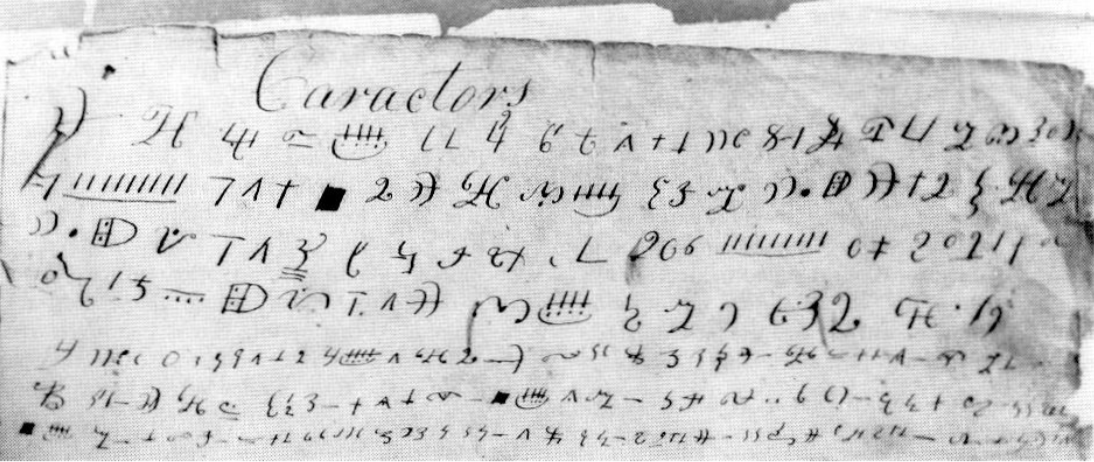
Copy of the Anthon transcript in the temple archives of the Community of Christ
Joseph Smith’s account of Martin Harris’ visit with Professor Anthon is given in the Pearl of Great Price, Joseph Smith—History 1:62–65:
. . . I [Joseph Smith] commenced copying the characters off the plates. I copied a considerable number of them, and by means of the Urim and Thummim I translated some of them, . . . Mr. Martin Harris came to our place, got the characters which I had drawn off the plates, and started with them to the city of New York. For what took place relative to him and the characters, I refer to his own account. . . .
I [Martin Harris] went to the city of New York, and presented the characters which had been translated, with the translation thereof, to Professor Charles Anthon, . . . Professor Anthon stated that the translation was correct, more so than any he had before seen translated from the Egyptian. I then showed him those which were not yet translated, and he said that they were Egyptian, Chaldaic, Assyriac, and Arabic; and he said they were true characters. He gave me a certificate, certifying to the people of Palmyra that they were true characters, and that the translation of such of them as had been translated was also correct . . . .
In continuing to print the story of Martin’s visit with Professor Anthon in their scriptures, the LDS Church is perpetuating the claim that Anthon verified the characters and translation. Notice that Martin claims that Anthon verified that there were “Egyptian, Chaldaic, Assyriac, and Arabic” on the sample of Book of Mormon characters. One wonders why there would be these various scripts on the plates when supposedly Mormon abridged the Nephite records in about 385 AD in “reformed Egyptian.”63
Another question that comes to mind is how could Anthon verify the translation if only a seer could decipher the message in the unknown language? While several years later Professor Anthon acknowledged Harris’ visit, he insisted that he had not said the “translation was correct”:
New York, Feb. 17, 1834.
Dear Sir—. . . The whole story about having pronounced the Mormonite inscription to be “reformed Egyptian hieroglyphics” is perfectly false. Some years ago, a plain, and apparently simple-hearted farmer, called upon me with a note from Dr. Mitchell of our city, now deceased, requesting me to decypher, if possible, a paper, which the farmer would hand me, . . .
Upon examining the paper in question, I soon came to the conclusion that it was all a trick, perhaps a hoax. . . . This paper was in fact a singular scrawl. It consisted of all kinds of crooked characters disposed in columns, and had evidently been prepared by some person who had before him at the time a book containing various alphabets. Greek and Hebrew letters, crosses and flourishes, Roman letters inverted or placed sideways, were arranged in perpendicular columns, and the whole ended in a rude delineation of a circle divided into various compartments, decked with various strange marks, . . . [I] well remember that the paper contained any thing else but “Egyptian Hieroglyphics.” . . .64
[See entire letter here.]
Linguists today side with Anthon’s assessment that the document does not represent a real language. Obviously Martin Harris either misrepresented or misunderstood his conversation with Anthon. Yet Joseph Smith presented this sample as a literal copy of the characters on an ancient record—that he, Smith, had successfully translated. For nearly 200 years the LDS Church has pointed to this event as proof of the legitimacy of Smith’s translation, in spite of the fact that the Anthon transcript doesn’t match any known script. It actually contains quite a few English characters and numbers. To illustrate this we have taken various characters from the Anthon transcript and arranged them in a sentence.65

When we look for samples of writing in the New World during the Book of Mormon time frame, we find multiple examples of the Mayan script. But no example of the kind of script shown to Anthon has been discovered in the Americas. If the Anthon transcript is a modern invention, then the Book of Mormon is one as well, since they both originated with the same person, Joseph Smith.
Importance of Book of Mormon Plates
While some today try to minimize the importance of the Nephite plates being an actual ancient record, the Book of Mormon itself presents a story of numerous ancient prophets writing on physical plates. According to the story, these records were condensed and protected by Mormon, who in turn passed the records on to his son Moroni. At the end of the book, Moroni is left to wander the continent and finally to transport these records to the Hill Cumorah in New York. To aid students in their study of the Book of Mormon, the LDS Church released a new video66 this year featuring a re-enactment of Moroni, at approximately 421 AD, burying the plates in the hill where, hundreds of years later, he will appear to Joseph Smith as an angel and lead him to the long-lost record.
The enormity of the job of condensing the Nephite and Jaredite records done by Mormon and Moroni is illustrated by LDS scholar John Tvedtnes in his overview of the many plates mentioned in the Book of Mormon:
The Nephites kept a large number of records for the benefit of future generations (Hel. 3:13, 15–16). The importance of record-keeping is stressed in the story of Nephi, who, before leaving the Old World, obtained the BRASS PLATES from Laban in Jerusalem (1 Ne. 3; 1 Ne. 4). These plates were apparently handed down in the Nephite royal line, for King Mosiah I had them. (Omni 1:14.)
Arriving in the New World, Nephi prepared two sets of plates (1 Ne. 19:1–6). The LARGE PLATES OF NEPHI were passed down by the kings to Benjamin, son of Mosiah I (Omni 1:11; W of M 1:10).
The SMALL PLATES OF NEPHI came down in a different line. The first part of our present Book of Mormon (1 Nephi through the Words of Mormon) comes from the small plates. The men who wrote on them referred to them as “these plates,” while referring to the large plates held by the kings as the “other plates.” . . .
Amaleki, noting that the plates were almost filled, turned them over to King Benjamin (Omni 1:25), who added them to the “other plates” (W of M 1:10). Thus King Benjamin possessed the plates of brass, as well as all of the plates of Nephi. (Mosiah 1:3–4, 6.) These he passed on to his son, Mosiah II (Mosiah 1:16; Mosiah 28:11).
King Mosiah II added to the large plates of Nephi the records of Zeniff and Alma (Mosiah 25:5–6). He also came into possession of 24 GOLD PLATES containing the Jaredite history (Mosiah 28:11–13, 17–20). He gave all of the plates to Alma II (Mosiah 28:20), and from him they were passed on . . .
Ammaron hid the plates in the hill Shim. (4 Ne. 1:48.) He then chose young Mormon as his successor and instructed him to remove the plates of Nephi from the hill in his 24th year. (Morm. 1:1–4.) At the appropriate time Mormon took the plates. He updated the history on the large plates, then began an abridgement of these on a separate set of plates (Morm. 2:17–18).
Later, because of the Lamanite danger, Mormon removed the rest of the plates from the hill Shim (Morm. 4:23). He completed his abridgement of the large plates and hid most of the Nephite records in the Hill Cumorah, except for his own abridgement and the small plates of Nephi, which he gave to his son Moroni (Morm. 6:6; W of M 1:1–7).
Moroni finished the record of his father on the abridgement. (Morm. 8:1, 13.) Then he wrote a preface to his father’s work, which is the first paragraph of the present-day preface to the Book of Mormon.
Later Moroni found sufficient time to add an abridgement of the 24 gold plates, or Book of Ether (Ether 1:1–5), and even to write some of his own thoughts (Moro. 1:1–4). He then wrote the second paragraph of the preface and hid the plates.
A little over 1,400 years later Moroni turned over the abridged Nephite records to Joseph Smith.67
Yet, after that monumental effort to gather the records, make an abridgement, transport, and hide the plates, they were not even needed since Smith merely read off the English translation by looking at a rock in his hat. So why preserve the plates for over two thousand years?
For those who suggest that the plates did not need to be literally in Smith’s possession, that he could have viewed them in a vision, one must remember that all of his story demands the presence of literal metal plates. According to Smith, the angel showed him the plates in 1823 but made him wait four years before he could physically retrieve the plates from the hill.68 Joseph’s mother, Lucy, recounted that when he finally brought them home he had to run through the woods carrying the plates in his coat in order to prevent thugs from stealing them.69 She also told of hiding the plates under the hearth.70 When Joseph moved away from Manchester, New York, the plates were supposedly hid in a barrel of beans.71
Joseph Smith gave a detailed description of the plates as measuring “six inches wide and eight inches long, and not quite so thick as common tin. They were filled with engravings, in Egyptian characters, and bound together in a volume as the leaves of a book, with three rings running through the whole. The volume was something near six inches in thickness, a part of which was sealed.”72
Martin Harris estimated the weight of the plates at “forty or fifty pounds.”73 Emma Smith told her son that she “moved them [the covered plates] from place to place on the table, as it was necessary in doing my work.”74
When Smith finished his translation, he returned the plates to the angel:
But by the wisdom of God, they [the plates] remained safe in my hands, until I had accomplished by them what was required at my hand. When, according to arrangements, the messenger called for them, I delivered them up to him, and he has them in his charge until this day, being the second day of May, one thousand eight hundred and thirty-eight.75
All of the early accounts of Smith being shown the plates by an angel, retrieving them from the hill, showing them to witnesses, hiding them in the woods, storing them on the table, returning them to the angel, etc., would make no sense if there was no physical object, whether real or invented. If the ancient plates did not literally exist, Smith’s story is a fabrication.
Mormon’s Abridgment
The title page of the Book of Mormon reads:
An account written by the hand of Mormon upon plates taken from the plates of Nephi . . . Wherefore, it is an abridgment of the record of the people of Nephi, and also of the Lamanites.
Considering the effort needed to make the original gold plates of the Book of Mormon, to engrave them, and then abridge them, one would expect a scribe to be as concise as possible, not wordy. For example, Nephi’s brother, Jacob, complained: “I cannot write but a little of my words, because of the difficulty of engraving our words upon plates” (Book of Mormon, Jacob 4:1).
However, lengthy sentences abound in the Book of Mormon. Here is just one example:
And now it came to pass that according to our record, and we know our record to be true, for behold, it was a just man who did keep the record—for he truly did many miracles in the name of Jesus; and there was not any man who could do a miracle in the name of Jesus save he were cleansed every whit from his iniquity—And now it came to pass, if there was no mistake made by this man in the reckoning of our time, the thirty and third year had passed away; And the people began to look with great earnestness for the sign which had been given by the prophet Samuel, the Lamanite, yea, for the time that there should be darkness for the space of three days over the face of the land.
(3 Nephi 8:1–3)
One could more easily imagine such long, rambling descriptions coming from someone spontaneously dictating to a scribe (as Joseph evidently did) than from someone painstakingly engraving each word of a long historical record. Since Smith was supposedly translating Mormon’s abridgment of the extensive history of his people, such wordy sentences become problematic.
One of the clues that Joseph Smith was not translating an ancient record but orally telling a story is his oft-used phrase “in other words.”76 For example, Mosiah 7:27 reads: “He should take upon him the image of man, and it should be the image after which man was created in the beginning; or in other words, he said that man was created after the image of God. . . .”
The combination “in other words” is used once by Smith in the 1830 preface to the Book of Mormon, twelve times in the text, three times in the Doctrine and Covenants, and three times in his new Bible translation. Yet the phrase does not appear in the King James Bible.77 It appears to be a staple in Smith’s storytelling, but hardly something one would expect in an abridged historical record.
Did the Witnesses See Physical Plates?
In the official statement at the front of the Book of Mormon, Martin Harris, Oliver Cowdery, and David Whitmer declared:
And we also testify that we have seen the engravings which are upon the plates; and they have been shewn unto us by the power of God, and not of man. . . . an Angel of God came down from heaven, and he brought and laid before our eyes, that we beheld and saw the plates, and the engravings thereon; and we know that it is by the grace of God the Father and our Lord Jesus Christ, that we beheld and bear record that these things are true.
The testimony of the Three Witnesses leaves a person with the impression that they all saw the angel and the gold plates at the same time; however, such was not the case. In his History of the Church, Joseph Smith admitted that Martin Harris was not with David Whitmer and Oliver Cowdery when they saw the plates. Joseph started by having the three witnesses pray in an effort to obtain a view of the plates, but to no avail. Finally:
Upon this, our second failure, Martin Harris proposed that he should withdraw himself from us, believing, as he expressed himself, that his presence was the cause of our not obtaining what we wished for. He accordingly withdrew from us, and we knelt down again, . . . presently we beheld a light above us in the air, of exceeding brightness; and behold, an angel stood before us. In his hands he held the plates. . . .
I [Joseph Smith] now left David and Oliver, and went in pursuit of Martin Harris. . . . We accordingly joined in prayer, and ultimately obtained our desires, for before we had yet finished, the same vision was opened to our view, at least it was again opened to me, whilst at the same moment, Martin Harris cried out, apparently in an ecstasy of joy, “‘Tis enough; ‘tis enough; mine eyes have beheld; mine eyes have beheld;” . . .78
Notice that the emphasis is on a miraculous event, not a normal, physical examination of the object. If the covered plates had been physically laying on the table for a couple of months during the translation, why weren’t they simply uncovered? Why would the witnesses need to go out into the woods to pray? Why would an angel need to appear in a vision to show them the plates? Some of the statements by the witnesses suggest a physical viewing of the plates. But these accounts need to be compared with their other statements that clearly tell of a vision experience.79
John H. Gilbert, the printer who set the type for the Book of Mormon, recounted a conversation he had with Martin Harris:
I said to him, —“Martin, did you see those plates with your naked eyes?” Martin looked down for an instant, raised his eyes up, and said, “No, I saw them with a spiritual eye.”80
[See entire typescript here.]
Early Mormon convert Stephen Burnett became disillusioned with Joseph’s claims when in 1838 he heard Martin Harris say he had not physically seen the plates:
I have reflected long and deliberately upon the history of this church & weighed the evidence for & against it—loth to give it up—but when I came to hear Martin Harris state in a public congregation that he never saw the plates with his natural eyes only in vision or imagination, neither Oliver [Cowdery] nor David [Whitmer] & also that the eight witnesses never saw them & hesitated to sign that instrument for that reason, but were persuaded to do it, the last pedestal gave way, in my view our foundations was sapped & the entire superstructure fell a heap of ruins, I therefore three week since in the Stone Chapel gave a full history of the church since I became acquainted with it, the false preaching & prophecying etc. of Joseph together with the reasons why I took the course which I was resolved to do, and renounced the Book of Mormon with the whole scene of lying and deception practiced by J. S [Joseph Smith] & S. R [Sidney Rigdon] in this church . . .
I was followed by W. Parish Luke Johnson & John Boynton all of who concurred with me, after we were done speaking M Harris arose & said he was sorry for any man who rejected the Book of Mormon for he knew it was true, he said he had hefted the plates repeatedly in a box with only a tablecloth or a handkerchief over them, but he never saw them only as he saw a city through a mountain. And said that he never should have told that the testimony of the eight [witnesses] was false, if it had not been picked out of [h]im but should have let it passed as it was . . .81
If it doesn’t require faith to see the table in the room, why would it take faith to see metal plates laying on the table? Joseph could have simply removed the cloth and displayed the artifact.
The Parchment of John
Towards the end of the Gospel of John in the New Testament is a discussion between the resurrected Christ and Peter regarding John’s future duties. Jesus asked Peter: “If I will that he [John] tarry till I come, what is that to thee” (John 21:21–23)? This resulted in confusion among the early Christians about whether or not John was promised to remain on earth until Christ’s return.
However, for Mormons this was settled in the Book of Mormon when the ancient disciples in America were visited by the resurrected Christ and were given a similar promise. Jesus instructed three of the Nephite disciples, “Behold, I know your thoughts, and ye have desired the thing which John, my beloved, who was with me in my ministry, before that I was lifted up by the Jews, desired of me. . . . for ye shall never taste of death; but ye shall live to behold all the doings of the Father . . . And ye shall never endure the pains of death” (3 Nephi 28:6–8). The narrative goes on to tell that these three men, along with John, “will be among the Gentiles, and the Gentiles shall know them not” (3 Nephi 28:27).
Possibly working on this section of the Book of Mormon brought the subject to Joseph Smith and Oliver Cowdery’s attention. At any rate, in 1829 they had a discussion on the possibility that Jesus, in John 21:21–23, promised John he would live until Christ returned. As a result, Joseph Smith claimed to receive a revelation of a “parchment” written and hidden by John, disciple of Jesus.82
This parchment, presumably written in Greek, promised John that he would live until Christ’s return. This record was hidden somewhere and later revealed to Smith. Smith’s 1829 translation of the text was published in the Book of Commandments (1833) but later expanded in the 1835 edition of the Doctrine and Covenants. If Joseph’s 1833 printed translation was actually from an ancient record written by John, why would he later expand it, adding words throughout the text? Below is the 1835 version of the revelation:
1835 Doctrine and Covenants, Section 33
(Section 7 in current editions)
[With words added in 1835 in bold type.]
1 And the Lord said unto me, John, my beloved, what desirest thou? For if ye shall ask, what you will, it shall be granted unto you. And I said unto him, Lord, give unto me power over death, that I may live and bring souls unto thee. And the Lord said unto me, Verily, verily, I say unto thee, because thou desiredst this thou shalt tarry until I come in my glory, and shalt prophesy before nations, kindreds, tongues and people.
2 And for this cause the Lord said unto Peter, If I will that he tarry till I come, what is that to thee? For he desiredst of me that he might bring souls unto me; but thou desiredst that thou might speedily come unto me in my kingdom. I say unto thee, Peter, this was a good desire, but my beloved has desired that he might do more, or a greater work, yet among men than what he has before done; yea, he has undertaken a greater work; therefore, I will make him as flaming fire and a ministering angel: he shall minister for those who shall be heirs of salvation who dwell on the earth; and I will make thee to minister for him and for thy brother James: and unto you three I will give this power and the keys of this ministry until I come.
3 Verily I say unto you, ye shall both have according to your desires, for ye both joy in that which ye have desired.
[See: Chart to Cross Reference Chapters/Sections in Book of Commandments/Doctrine and Covenants (PDF)]
It seems that Smith felt free to revise his translations to fit his current ideas. Notice that verse 2 is expanded to include the concept of Peter, James, and John holding the keys of power, bolstering his concept of priesthood that was brought into the church sometime after its founding in 1830.83 How are we to take Smith’s claim of “translating” ancient documents seriously if he is able to go back and add to and revise them as his theology expands?
Joseph’s Bible Revision
In the LDS Articles of Faith, Joseph Smith wrote “We believe the Bible to be the word of God as far as it is translated correctly; we also believe the Book of Mormon to be the word of God.”84 Thus the Book of Mormon is accepted as reliable while the Bible is approached with skepticism. In fact, Joseph’s new book of scripture specifically undermines the Bible by claiming that “Many parts which are plain and most precious; and also many covenants” have been removed.85
Soon after finishing the Book of Mormon, Joseph Smith set out to remedy the problem of a corrupted Bible by producing his own version, known as the Joseph Smith Translation (JST) or Inspired Version. Not knowing any biblical languages or having access to any ancient manuscripts, Smith would produce his Bible through revelation.
Between the years 1830 and 1833, Smith and his scribes went through the Bible noting places to be changed, plus adding new verses to the text. The importance of the work can be seen by the many revelations regarding the revision in the Doctrine and Covenants.86 It wasn’t published until 1867, long after Smith’s death, by the Reorganized Church of Jesus Christ of Latter Day Saints, now known as the Community of Christ.87
Some of the changes were Smith’s attempt to make a more logical reading, some were simply insertions by Smith, and other changes were issues discussed in Bible commentaries.88 Joseph Smith’s extensive use of Adam Clarke’s Bible Commentary has recently been discussed in the book Producing Ancient Scripture. Thomas A. Wayment and Haley Wilson Lemmon observed:
The direct parallels between Adam Clarke’s commentary on the Bible and Joseph Smith’s revision of the Bible are simply too numerous and too close to explain as mere coincidence or happenstance. Parallels between the two texts number into the hundreds . . .89
As with the Book of Mormon, Smith imported aspects of New Testament Christianity into his revision of the Old Testament. For instance, in his revision of Genesis, as printed by the Community of Christ, he indicates that Adam was baptized in the name of Jesus Christ and received the Holy Ghost:
And he called upon our father Adam, by his own voice, saying, I am God; . . . If thou wilt, turn unto me and hearken unto my voice, and believe, and repent of all thy transgressions, and be baptized, even in water, in the name of mine Only Begotten Son, who is full of grace and truth, which is Jesus Christ, the only name which shall be given under heaven, whereby salvation shall come unto the children of men; and ye shall receive the gift of the Holy Ghost, asking all things in his name, and whatsoever ye shall ask it shall be given you . . .90
This same passage is printed in the LDS Pearl of Great Price, Book of Moses 6:51–52. While Enoch receives only passing mention in the Bible, Smith added pages to Genesis, chapters 6 and 7 about Enoch and his city. He also added over 800 words to Genesis chapter 50, including a prophecy about himself. In 1979 the LDS Church printed their own Bible, using the KJV, and added their own cross-references and extracts from the Joseph Smith Translation. For example, at the back of their Bible, Genesis 50:33 of Joseph Smith’s revision reads:
And that seer will I bless, and they that seek to destroy him shall be confounded; for this promise I give unto you; for I will remember you from generation to generation; and his name shall be called Joseph, and it shall be after the name of his father.91
This was obviously intended to be a reference to Joseph Smith, whose father was also named Joseph. Furthermore, Genesis 14 was expanded to enlarge the role of Melchizedek and his priesthood.
Likewise, Isaiah received numerous corrections, with chapter 29 being greatly expanded. This was done so that the passage about a sealed book could be reinterpreted as a prophecy about the Book of Mormon.92 Interestingly, his revision of Isaiah still retains the verses declaring that there is only one God, such as Isaiah 43:10–11, which contrasts with Smith’s later teachings on a multitude of Gods.
The Book of Mormon states that the Old Testament went “from the Jews in purity unto the Gentiles,” but was then changed after the time of the apostles by “That great and abominable church.”93 With the discovery of the Dead Sea Scrolls, it is now clear that Smith’s additions to the Old Testament are not supported by ancient manuscripts. Also, Christianity was not taught in the Old Testament.94
Smith also added many words to the New Testament, even rewriting the well-known opening of the Gospel of John.
| John 1:1 (KJV) | John 1:1 (JST) |
|---|---|
| In the beginning was the Word, and the Word was with God, and the Word was God. | In the beginning was the gospel preached through the Son. And the gospel was the word, and the word was with the Son, and the Son was with God, and the Son was of God. |
Needless to say, there is no manuscript evidence for Smith’s additions.95
In examining the Sermon on the Mount, we find the Book of Mormon version follows Matthew’s account in the KJV. But the Joseph Smith Bible (JST) revision is longer, which leads to the question: Which is the accurate version?
| Matthew 7:6 (KJV) | 3 Nephi 14:6 | Matthew 7:10–11 (JST) |
|---|---|---|
| 6 Give not that which is holy unto the dogs, neither cast ye your pearls before swine, lest they trample them under their feet, and turn again and rend you. | 6 Give not that which is holy unto the dogs, neither cast ye your pearls before swine, lest they trample them under their feet, and turn again and rend you. | 10 And the mysteries of the kingdom ye shall keep within yourselves; for it is not meet to give that which is holy unto the dogs; neither cast ye your pearls unto swine, lest they trample them under their feet. 11 For the world cannot receive that which ye, yourselves, are not able to bear; wherefore ye shall not give your pearls unto them, lest they turn again and rend you. |
One change he made in Revelation 1:6 was to reinforce the doctrine of one God. In the KJV it says that we are made “kings and priests unto God and his Father.” To eliminate any confusion that two gods are meant, Smith dropped the word “and,” so that it read “God, his Father.” However, preaching in 1844, Smith completely ignored his own revision, and used the KJV reading “God and his Father” to bolster his new doctrine that there was a God above our Heavenly Father.96 This is just one of many instances of Smith’s evolving view of the godhead.
Curiously, Smith seemed to ignore his revision once it was finished, choosing instead to quote from the KJV or give a new rendering in his sermons. Writing in 1963, LDS writer Merrill Y. Van Wagoner explained:
Whenever the prophet quoted from the Bible he either retained the words of the King James version or else flatly declared it to be wrong and then gave a rendering of the passage which differed from it. He seems to take no account of his changes in the Inspired Revision, which of course was not printed.97
One example of this is seen in his various renditions of Malachi 4:1–6. Recounting the visitation by the angel Moroni during his teenage years, Joseph told how Moroni quoted from these verses:
. . . he [Moroni] quoted also the fourth or last chapter of [Malachi] the same prophecy, though with a little variation from the way it reads in our Bibles. Instead of quoting the first verse as it reads in our books, he quoted it thus: For behold, the day cometh that shall burn as an oven, and all the proud, yea, and all that do wickedly shall burn as stubble, for they that come shall burn them, saith the Lord of Hosts, that it shall leave them neither root nor branch.
And again, he quoted the fifth verse thus: Behold, I will reveal unto you the Priesthood, by the hand of Elijah the prophet, before the coming of the great and dreadful day of the Lord.
He also quoted the next verse differently: And he shall plant in the hearts of the children the promises made to the fathers, and the hearts of the children shall turn to their fathers. If it were not so, the whole earth would be utterly wasted at his coming.98
Curiously, when Christ appears in the New World and quotes Malachi, it is slightly different from Moroni’s quote to Smith:
Behold, I will send you Elijah the prophet before the coming of the great and dreadful day of the Lord; And he shall turn the heart of the fathers to the children, and the heart of the children to their fathers, lest I come and smite the earth with a curse.
(3 Nephi 25:5–6)
However, when Smith was working on his Inspired Revision, he marked the book of Malachi as “correct.” But this is not the end of the confusion. Joseph Smith, preaching on January 24, 1844, gave yet another rendering of Malachi 4:5–6. Although he followed the wording of the King James Version, he claimed that the word “turn” should be translated “bind” or “seal”—a rendering which he did not use in either the Book of Mormon or the Inspired Version.99
Mormons often object to the form of our current biblical canon, maintaining that early Christian councils decided which books were to be canonized and thus voted out many books that should have been included in the Bible. Interestingly, Smith did not restore any of these “lost” writings.100 In fact, he even eliminated the Song of Solomon from his Bible.
When the LDS Church printed its own edition of the King James Bible, the leaders certainly could have made their own compilation of books to be included in the canon. But they left it the same. While they did not make any alterations to the actual text, they did introduce new chapter headings and footnotes which cross-referenced their other books of scripture.
Included at the back of the official LDS Bible (KJV) are numerous quotes from the Joseph Smith Bible revision. The Pearl of Great Price includes Smith’s revision of Genesis and extracts from Matthew 23–24. If these portions of his revision are considered divinely given, then why not use all that Smith had produced, even if the project wasn’t complete? Also, why not simply include his revisions in the biblical text, where they supposedly belong? If the KJV really was corrupt, wouldn’t this be the time to present it in its corrected state?
According to Joseph, the Lord wanted him to finish and publish the revised Bible during his lifetime.101 Since that never happened, one wonders why subsequent LDS prophets have never completed the task? It is claimed that they hold the same gifts and callings that Joseph Smith did. Yet their priorities still don’t seem to include restoring the Bible to its original form.
Conclusion
When Christians refer to various Bible translations, they are generally referring to such items as the King James Version (KJV), the New American Standard Bible (NASB), the New International Version (NIV), or the English Standard Version (ESV), among others. These all contain the same books, translated from the best ancient manuscripts available at the time. Anyone who takes the time to learn the biblical languages (Hebrew, Aramaic, and Greek) would be able to do their own translation of these manuscripts. However, no such undertaking is possible with Joseph Smith’s work. There are no ancient manuscripts for the Book of Mormon or the Joseph Smith Translation (JST) that could be translated by an independent linguist. Scholars now admit that Smith did not translate anything in the normal sense of the word. It appears that Joseph’s own imagination, coupled with Bible commentaries and literature of the day, provided the inspiration for his scriptures.
Footnotes:
- Richard S. Van Wagoner, Natural Born Seer: Joseph Smith, American Prophet, 1805-1830, (Salt Lake City: Smith-Pettit Foundation, 2016) pp. 375-422. Also, Dan Vogel, Joseph Smith and the Making of a Prophet, (Salt Lake City: Signature Books, 2004); B. H. Roberts, Studies of the Book of Mormon, (Salt Lake City: Signature Books, 1992); William L. Davis, Visions in a Seer Stone, (University of North Carolina Press, 2020); Wesley P. Walters, Use of the Old Testament in the Book of Mormon, (Salt Lake City: Utah Lighthouse Ministry, 1990); Jerald and Sandra Tanner, Joseph Smith’s Plagiarism of the Bible in the Book of Mormon, (Salt Lake City: Utah Lighthouse Ministry, 2010). ↩︎
- Peggy Fletcher Stack, “What you may not know about Mormon historian Richard Bushman — for one, he was agnostic when he went on his mission” (Salt Lake Tribune, Dec. 31, 2020). ↩︎
- Michael Hubbard Mackay and Nicholas J. Frederick, Joseph Smith’s Seer Stones (Provo: BYU Press, 2016), p. 46. Also see: Ulisses Soares, “The Coming Forth of the Book of Mormon,” LDS April Conference (2020). ↩︎
- Mackay and Frederick, Joseph Smith’s Seer Stones, p. 47. Also see: Blake T. Ostler, “The Book of Mormon as a Modern Expansion of an Ancient Source” (Dialogue: A Journal of Mormon Thought, Spring 1987). ↩︎
- John Dehlin, “Why the Catalyst Theory is Dead on Arrival,” (Aug. 16, 2020). ↩︎
- Fawn M. Brodie, No Man Knows My History (Alfred A. Knopf, 1971), chapters 4 and 5. For an LDS evaluation of the various fiction theories, see: Brian C. Hales, “Naturalistic Explanations of the Origin of the Book of Mormon,” (2019, BYU Studies, vol. 58, issue 3, article 5). ↩︎
- John-Charles Duffy, “The ‘Book of Mormon Translation’ Essay in Historical Context,” The LDS Gospel Topics Series: A Scholarly Engagement, Matthew L. Harris and Newell G. Bringhurst, eds., (Salt Lake City: Signature Books, 2020), pp. 100-122. ↩︎
- Gospel Topics Essays. ↩︎
- “Book of Mormon Translation,” Gospel Topics essay. ↩︎
- The Joseph Smith Papers, “Letter of Joseph Smith to Oliver Cowdery,” (October 22, 1829). ↩︎
- The Joseph Smith Papers, “Joseph Smith’s 1832 History.” ↩︎
- Lavina Fielding Anderson, ed., Lucy’s Book: A Critical Edition of Lucy Mack Smith’s Family Memoir, (Signature Books, 2001), p. 345. ↩︎
- H. Michael Marquardt, The Rise of Mormonism: 1816–1844, 2nd ed. (Xulon Press, 2013), pp. 30–31. ↩︎
- For further information on Joseph Smith’s schooling, see: William Davis, “Reassessing Joseph Smith Jr.’s Formal Education,” Dialogue: A Journal of Mormon Thought, Winter 2016, vol. 49, no. 4, p. 112. ↩︎
- Grant H. Palmer, “Joseph Smith, Captain Kidd, Cumorah, and Moroni,” John Whitmer Historical Journal, vol. 34, no. 1, pp. 50–57; also Marquardt, The Rise of Mormonism, pp. 24–27. ↩︎
- Wayne Sentinel, Palmyra, New York, (February 16, 1825): p. 1, column 5; [PDF version here] ↩︎
- Wayne Sentinel, (December 27, 1825): p. 2; [PDF version here] ↩︎
- Dan Vogel, “The Locations of Joseph Smith’s Early Treasure Quests,” Dialogue: A Journal of Mormon Thought, 27/3 (1994), pp. 197–231; also see D. Michael Quinn, Early Mormonism and the Magic World View, (Salt Lake City: Signature Books, 1998). ↩︎
- Willard Chase Affidavit, in E. D. Howe, Mormonism Unvailed, (Painesville, Ohio, 1834), pp. 240-241. ↩︎
- Dan Vogel, Early Mormon Documents, Vol. 2, (Salt Lake City: Signature Books, 1998), pp. 303–304. ↩︎
- Richard S. Van Wagoner, Natural Born Seer, p. 170. ↩︎
- Jerald and Sandra Tanner, Mormonism, Magic and Masonry, (Salt Lake City: Utah Lighthouse Ministry, 1988), pp. 2–5. ↩︎
- Quinn, Early Mormonism and the Magic World View, pp. 98–135. ↩︎
- Wesley P. Walters, Joseph Smith’s Bainbridge, N.Y., Court Trials, (Salt Lake City: Utah Lighthouse Ministry, 1977), pp. 128–142; also Marquardt, The Rise of Mormonism, pp. 42–45. ↩︎
- Marquardt, The Rise of Mormonism, p. 43. ↩︎
- Joseph Smith—History, Pearl of Great Price. ↩︎
- Interview with Martin Harris, Tiffany’s Monthly (1859), pp. 163–165, 167, 169. ↩︎
- Mormon Stories, “Folk Magic/Treasure Digging”;
Christopher Smith, “How the Book of Mormon Translation Story Changed Over Time.” ↩︎ - William Smith and Joseph Lewis statements, in The Amboy Journal (April 30, 1879); quoted in: “The Mormon Prophet Attempts to Join the Methodists”. ↩︎
- Anderson, Lucy’s Book, p. 418. ↩︎
- Doctrine and Covenants, Section 10. ↩︎
- The Joseph Smith Papers, “Book of Mormon (1830) Preface.” ↩︎
- Anderson, Lucy’s Book, p. 384. ↩︎
- M. T. Lamb, The Golden Bible, (1887), pp. 118–126; also Doctrine and Covenants, Section 10. ↩︎
- Jerald and Sandra Tanner, Joseph Smith’s Plagiarism of the Bible in the Book of Mormon, pp. 55, 169–174. ↩︎
- Gospel Topics, “Book of Mormon Translation.” ↩︎
- Pearl of Great Price, Joseph Smith—History 1:35. ↩︎
- Book of Mormon: Mosiah 8:13, 19; Mosiah 28:20; Alma 37:21, 24; Ether 4:5. ↩︎
- Jerald and Sandra Tanner, Mormonism—Shadow or Reality? (Salt Lake City: Utah Lighthouse Ministry, 1987), pp. 40–41. ↩︎
- Dr. Francis W. Kirkham, “The Manner of Translating the Book of Mormon,” Improvement Era, October 1939, p. 632. ↩︎
- Russell M. Nelson, “The Book of Mormon is Tangible Evidence of the Restoration,” (churchofjesuschrist.org). ↩︎
- M. T. Lamb, The Golden Bible, (1887), pp. 250–251. ↩︎
- Joseph Smith, Documentary History of the Church, 1:71. ↩︎
- Bible Hub, Interlinear Bible, https://biblehub.com/interlinear/matthew/1-1.htm ↩︎
- David Whitmer, Address to All Believers in Christ (Richmond, MO: David Whitmer, 1887), p. 12. ↩︎
- Gospel Topics, “Book of Mormon Translation.” See note 36. ↩︎
- History of the Church, 6:74. ↩︎
- Douglas D. Palmer, “Translators Help Send LDS Message Worldwide,” Deseret News, June 29, 1995. ↩︎
- Dieter F. Uchtdorf, “President Uchtdorf Shares What He Believes About Seer Stones,” LDS Living, June 21, 2016. ↩︎
- For examples and discussion, see: Jerald and Sandra Tanner, Joseph Smith’s Plagiarism of the Bible in the Book of Mormon; see also Introduction, 3,913 Changes in the Book of Mormon. ↩︎
- The Joseph Smith Papers, “Letter to Oliver Cowdery, 22 October 1829.” ↩︎
- Gilbert J. Hunt, The Late War Between the United States and Great Britain . . . in the Scriptural Style (1816). ↩︎
- Wesley P. Walters, “The Use of the Old Testament in the Book of Mormon,” Master’s Thesis (Trinity Evangelical Divinity School, 1981), pp. 68–69. ↩︎
- Edward Stevenson’s account of Martin Harris’ Sunday morning lecture in Salt Lake City, 4 September 1870, published in the LDS Millennial Star, Vol. 44 (6 February 1882), p. 87. ↩︎
- Gospel Topics, “Book of Mormon Translation.” ↩︎
- Michael H. MacKay and Nicholas J. Frederick, Joseph Smith’s Seer Stones, p. 141. ↩︎
- Doctrine and Covenants 28:2, 11–12. ↩︎
- D. Michael Quinn, Early Mormonism and the Magic World View, pp. 245–249. ↩︎
- Russell M. Nelson, “A Treasured Testament,” Ensign, July 1993. ↩︎
- Book of Mormon, 1 Nephi 3:19. ↩︎
- Daniel H. Ludlow, ed., Encyclopedia of Mormonism (New York: Macmillan Publications), pp. 179–180. ↩︎
- Richard E. Bennett, “Martin Harris and Three Wise Men,” BYU Speech, June 29, 2010. ↩︎
- Book of Mormon, Words of Mormon 1:3. ↩︎
- Charles Anthon, letter published in Mormonism Unvailed (1834), pp. 270–272. ↩︎
- “Joseph Smith’s ‘Caractors’ Found,” Salt Lake City Messenger, no. 43 (July 1980). ↩︎
- “Special Book of Mormon Videos Episode Celebrates Church’s Founding Event,” (September 16, 2020). ↩︎
- John Tvedtnes, “Composition and History of the Book of Mormon,” New Era, September 1974. ↩︎
- Pearl of Great Price, Joseph Smith—History 1:59. ↩︎
- Anderson, Lucy’s Book, pp. 385–386. ↩︎
- Ibid, p. 391. ↩︎
- Ibid, p. 401. ↩︎
- Joseph Smith, History of the Church, vol. 4, p. 537. ↩︎
- Tiffany’s Monthly, 1859, p. 166, reprinted in Dan Vogel, Early Mormon Documents, vol. 2, p. 306. ↩︎
- Saints’ Herald, October 1, 1879. ↩︎
- Joseph Smith, History of the Church, vol. 1, pp. 18–19. ↩︎
- Book of Mormon, 1 Nephi 8:2; 10:4; 19:7; Mosiah 7:27; Alma 13:7; 32:16; 40:2, 19; 46:21; 48:15. ↩︎
- Jerald and Sandra Tanner, Joseph Smith’s Plagiarism of the Bible in the Book of Mormon, pp. 40–41, 231. ↩︎
- Joseph Smith, History of the Church, vol. 1, pp. 54–55. ↩︎
- “Too Mean to Mention,” Salt Lake City Messenger, no. 117 (November 2011); see also Fair Mormon, “Quotations from David Whitmer which demonstrate the literal nature of the Three Witness experience.” ↩︎
- Royal Skousen, “Worthy of Another Look: John Gilbert’s 1892 Account of the 1830 Printing of the Book of Mormon,” Journal of Book of Mormon Studies, vol. 21, no. 2 (2012). For a typescript of the full Memorandum, see “John H. Gilbert (typesetter for the Book of Mormon).” ↩︎
- The Joseph Smith Papers, “Letter from Stephen Burnett to Lyman Johnson,” April 15, 1838, Joseph Smith Letterbook 2, pp. 64–66. ↩︎
- Book of Commandments, 1833, chapter 6. Revised in the 1835 Doctrine and Covenants, section 33. Now printed as section 7 of the Doctrine and Covenants. [See: Cross Reference Chart for Book of Commandments / Doctrine and Covenants (PDF)] ↩︎
- Michael Hubbard MacKay, Prophetic Authority: Democratic Hierarchy and the Mormon Priesthood, (University of Illinois Press, 2020), pp. 48–50. ↩︎
- “The Articles of Faith,” number 8, Joseph Smith, Pearl of Great Price. ↩︎
- Book of Mormon, 1 Nephi 13:26. ↩︎
- See the LDS online article, “Joseph Smith’s Bible Translation” for background. For full text of the JST (Joseph Smith Translation of the Bible, a.k.a., the Inspired Version) see it online at Centerplace.org, or purchase the hardcover book from Herald Publishing House. ↩︎
- H. Michael Marquardt, The Four Gospels According to Joseph Smith, (Longwood, FL: Xulon Press, 2007), pp. 42–44. ↩︎
- See Philip L. Barlow, Mormons and the Bible (Oxford, 1991), pp. 46–61. Also R. J. Matthews, “A Study of the Text of Joseph Smith’s Inspired Version of the Bible,” (PDF). ↩︎
- Michael Hubbard MacKay, Mark Ashurst-McGee, and Brian M. Hauglid, eds., Producing Ancient Scripture: Joseph Smith’s Translation Projects in the Development of Mormon Christianity (University of Utah Press, 2020), p. 267. ↩︎
- Joseph Smith’s “New Translation” of the Bible (Independence, Missouri: Herald House Publishers, 1970), Genesis 6:52–53, p. 47. ↩︎
- “Joseph Smith Translation,” Holy Bible (Salt Lake City: Church of Jesus Christ of Latter-day Saints, 1979), p. 799; cf., Community of Christ JST, Genesis 50:33. ↩︎
- Paul Trask, Part Way to Utah: The Forgotten Mormons (Independence, Missouri: Refiner’s Fire Ministries, 2005), chapter 9, pp. 103–112 (PDF). ↩︎
- Book of Mormon, 1 Nephi 13:24–29. ↩︎
- Walters, Use of the Old Testament. ↩︎
- Luke Wayne, “The Joseph Smith Translation and John 1:1,” CARM, July 1, 2019. ↩︎
- Joseph Fielding Smith, comp., Teachings of the Prophet Joseph Smith (Salt Lake City: Deseret Book), p. 370. ↩︎
- Merrill Y. Van Wagoner, The Inspired Revision of the Bible (Salt Lake City: Deseret Book, 1963), pp. 48–51. ↩︎
- Joseph Smith—History 1:36–39, Pearl of Great Price. ↩︎
- History of the Church, vol. 6, chp. 8, pp. 183–184. See also Jerald and Sandra Tanner, Mormon Scriptures and the Bible (Salt Lake City: Utah Lighthouse Ministry, 1970). ↩︎
- Robert M. Bowman, Jr., “Mormonism and Alleged ‘Lost Books’ of the Bible,” Institute for Religious Research (September 22, 2014). ↩︎
- Robert J. Matthews, “Joseph Smith’s Efforts to Publish His Bible ‘Translation,’” Ensign, January 1983. ↩︎

Originally appeared in: