
By Sandra Tanner

Joseph Smith, the founder of the Church of Jesus Christ of Latter-day Saints, claimed that when he was seventeen years old, a heavenly messenger appeared to him in his bedroom in Western New York to commission him to translate an ancient record containing God’s dealings with the forefathers of the Native Americans. The angel, later identified as Moroni, explained that he was once a mortal and was the last person to write on the sacred plates, which he had hid in a stone box in a nearby hill in approximately 421 A.D. He explained that the record contained “an account of the former inhabitants of this continent,” and that they also contained “the fulness of the everlasting Gospel.” Also stored in the box was the sword of Laban, a breast plate and the Urim and Thummim (described as large spectacles) to aid in translating the record.
Four years later, on September 22, 1827, the angel allowed Smith to retrieve the plates and the Urim and Thummim from the hill, and sometime later he began his translation. Upon completion, Joseph Smith claimed that he returned the gold plates to the angel and published the book in 1830 under the title The Book of Mormon. Included in the book were two statements, one signed by three men attesting that an angel had appeared to them and showed them the gold plates. The other statement, signed by eight witnesses, affirmed that they had seen the plates. In this article we will look at some of the background of these men.

The Translation Process
Writing in 1842, Rev. Henry Caswall related a description of the plates and the heavenly instruments by Joseph’s mother, Lucy Smith:
My son Joseph has had revelations from God since he was a boy, and he is indeed a true prophet of Jehovah. The angel of the Lord appeared to him fifteen years since, and shewed him the cave where the original golden plates of the book of Mormon were deposited. He shewed him also the Urim and Thummim, by which he might understand the meaning of the inscriptions on the plates, and he shewed him the golden breastplate of the high priesthood. . . . I have myself seen and handled the golden plates; they are about eight inches long, and six wide; some of them are sealed together and are not to be opened, and some of them are loose. . . .
I have seen and felt also the Urim and Thummim. They resemble two large bright diamonds set in a bow like a pair of spectacles. My son puts these over his eyes when he reads unknown languages, and they enable him to interpret them in English.1

When and how Lucy Smith saw the plates and the Urim and Thummim has never been explained. We assume it was in a vision or dream since she wasn’t one of the Book of Mormon witnesses. Also, none of the people who witnessed Smith during his translation activities describe him actually using the spectacles. Even Joseph Smith’s wife, Emma, who was one of his scribes, was never permitted to see the plates.
After Martin Harris, one of Smith’s scribes and benefactor, lost the first 116 pages of the manuscript, the work of translation shifted from using the Urim and Thummim to using Smith’s seer stone, found in a neighbor’s well in 1822, five years before receiving the plates.2 Emma Smith tells how this happened in an 1870 letter to Emma Pilgrim:
Now the first that my [husband] translated, was translated by the use of the Urim and Thummim, and that was the part that Martin Harris lost, after that he used a small stone, not exactly, black, but was rather a dark color . . . 3
Emma gave the following description of the translation process:
“In writing for your father I frequently wrote day after day, after sitting by the table close by him, he sitting with his face buried in his hat, with the stone in it, and dictating hour after hour with nothing between us.”4
[Bold in quotations is added for emphasis and does not appear in originals.]
Curiously, in illustrating various instruction manuals, the LDS Church does not depict Smith using either the Urim and Thummim or the seer stone. He is almost always shown sitting at a desk and simply looking at the plates, as though he were doing a regular translation.

Del Parson’s illustration of Joseph Smith “translating” from the gold plates to his scribe.
(LDS Media Library, LDS.org)
Money-Digging
During the same time period that the angel was supposedly grooming Smith for the role of “Seer” (before allowing him to retrieve the plates) he and his father were involved in treasure digging. In the early 1820’s Joseph was often sought out as a “seer” who could discern the location of buried treasures by looking at his stone.5 When Martin Harris was interviewed in 1859 he mentioned Smith’s early use of his stone:
Joseph had a stone which was dug from the well of Mason Chase, . . . It was by means of this stone he first discovered these plates. . . . Joseph had had this stone for some time. There was a company there in that neighborhood, who were digging for money supposed to have been hidden by the ancients. Of this company were old Mr. Stowel—I think his name was Josiah—also old Mr. [Alvah] Beman, also Samuel Lawrence, George Proper, Joseph Smith, jr., and his father, and his brother Hiram Smith. They dug for money in Palmyra, Manchester, also in Pennsylvania, and other places. When Joseph found this stone, there was a company digging in Harmony, Pa., and they took Joseph to look in the stone for them, and he did so for a while, and then he told them the enchantment was so strong he could not see, and they gave it up. There he became acquainted with his future wife, the daughter of old Mr. Isaac Hale, where he boarded.6
While Smith was acting as “seer” for the money-digging group, he was arrested in 1826 in Chenango County, New York, jailed and appeared before Justice Albert Neeley. He was charged with a misdemeanor for claiming magical powers to find buried treasure. Joseph’s defense was that he truly had the gift but had given up looking in his stone to find treasures as it hurt his eyes. In Justice Neeley’s court record Smith reportedly said:
That he [Joseph Smith] had a certain stone which he had occasionally looked at to determine where hidden treasures in the bowels of the earth were; that he professed to tell in this manner where gold mines were a distance underground, and had looked for Mr. Stowel[l] several times, . . . that he had occasionally been in the habit of looking through this stone to find lost property for three years, but of late had pretty much given it up on account of its injuring his health, especially his eyes, made them sore. . . . 7
However, rather than giving up the use of his magic stone all together, Smith simply changed the way he used it, from treasure hunting to translating the Book of Mormon plates.
Magic Involvement

Contrary to the Bible’s strong denunciation of magic and necromancy in Deuteronomy 18:9-14, Joseph Smith and many, if not all, of the witnesses had been involved in the magic practices of the area, believing in ghosts who guarded buried treasures, using magic spells and paraphernalia.
Besides Joseph Smith’s seer stone, he also owned a magic Jupiter talisman (a silver medallion worn on a string around the neck).8 Mormon historian Reed C. Durham made these observations about Smith’s talisman in his presidential address to the Mormon History Association on April 20, 1974:
All available evidence suggest that Joseph Smith the Prophet possessed a magical Masonic medallion, or talisman, which he worked during his lifetime and which was evidently on his person when he was martyred. His talisman is in the shape of a silver dollar and is probably made of silver or tin. . . . [it] can now be identified as a Jupiter talisman. It carries the sign and image of Jupiter and should more appropriately be referred to as the Table of Jupiter. . . .
In astrology, Jupiter is always associated with high positions, getting one’s own way, and all forms of status.9

Front and back of Joseph Smith’s Jupiter talisman
Joseph’s brother, Hyrum, who was one of the eight witnesses to the Book of Mormon, also owned magic parchments and a magic dagger. These artifacts are currently in the possession of Elred G. Smith, Patriarch emeritus of the LDS Church and great, great-grandson of Hyrum Smith. Mormon writer Pearson H. Corbett describes relics of Hyrum Smith in his book, Hyrum Smith—Patriarch:
Dagger, Masonic—ten inch, stainless steel—wooden handle—Masonic symbols on blade.
Emblematic parchments—Masonic—three, original hand painted on heavy bodied paper—on border appears initials “I.H.S.”. . .
Pouch, Masonic cotton fabric 4”x 4” with draw string attached.10

Historian D. Michael Quinn made the following observation about the Smith family’s magic artifacts:
The three magic parchments possessed by the Smith family have three different purposes, all interrelated. The “Holiness to the Lord” parchment is a lamen of ceremonial magic to receive visitation from “good angels.” The “Saint Peter bind them” parchment is a talisman for personal protection. The faded “Jehovah, Jehovah, Jehovah” parchment is a house-amulet.11
Joseph Smith’s mother, Lucy Smith, told of the family’s magic involvement in the preliminary draft of her family history, although defending it as something that never interfered with their regular work:
I shall change my theme for the present but let not my reader suppose that because I shall pursue another topic for a season that we stopt our labor and went tryin=g to win the faculty of Abrac [,] drawing Magic circles or sooth saying to the neglect of all kinds of bus<i>ness we never during our lives suffered one important interest to swallow up every other obligation but whilst we worked with our hands we endeavored to remmember the service of & the welfare of our souls.12 [original spelling retained]
In Acts 19:19 we read of some people who “used curious arts” before they were converted to Christianity. At the time they confessed the Lord, however, they “brought their books together, and burned them before all men: and they counted the price of them, and found it fifty thousand pieces of silver.” Unlike the early Christians who destroyed their magic paraphernalia, the Smiths preserved their magic artifacts. In fact, the LDS Church has preserved several of Smith’s seer stones in their church vault.13

(from D. Michael Quinn’s book, Early Mormonism and the Magic World View; Figure 8)
A young man named Oliver Cowdery, who became one of Joseph Smith’s most important scribes and one of the three witness to the Book of Mormon, was also involved in magic, using a forked divining rod.14 Shortly after Cowdery became a scribe, Smith received a revelation mentioning Cowdery’s special gift. The 1829 revelation, printed in the 1833 Book of Commandments, spoke of Cowdery’s “gift of working with the rod,” which was referred to as his “rod of nature” which he held in his hands. However, when this revelation was reprinted in the 1835 edition of the Doctrine and Covenants, it underwent important rewording. Cowdery’s “rod of nature” became the “gift of Aaron” (Doctrine and Covenants 8:6-8). One assumes the word changes were made to disguise the obvious references to magic paraphernalia.15

Section 7 of the 1833 Book of Commandments.
The change from “rod of nature” to “gift of Aaron” was made
in the 1835 Doctrine and Covenants and is now printed as section 8.
Hiram Page, one of the eight witnesses, also had a seer stone which he used to obtain revelations. Joseph Smith charged that Page gave false revelations through his stone and that the other witnesses to the Book of Mormon were being influenced by his revelations:
To our great grief, however, we soon found that Satan had been lying in wait to deceive, . . . Brother Hiram Page had in his possession a certain stone, by which he obtained certain “revelations” . . . all of which were entirely at variance with the order of God’s house, . . . the Whitmer family and Oliver Cowdery, were believing much in the things set forth by this stone, we thought best to inquire of the Lord concerning so important a matter . . .16
Seeing a threat to his leadership, Joseph Smith countered with a revelation stating that “no one shall be appointed to receive commandments and revelations in this church excepting my servant Joseph Smith, Jun., for he receiveth them even as Moses” (Doctrine and Covenants 28:2). Then in verse eleven, Oliver Cowdery is instructed to tell Hiram Page that “those things which he hath written from that stone are not of me, and that Satan deceiveth him.”
In an 1859 interview Martin Harris recounted one of the events that convinced him that Joseph Smith truly had the gift of using a seer stone:
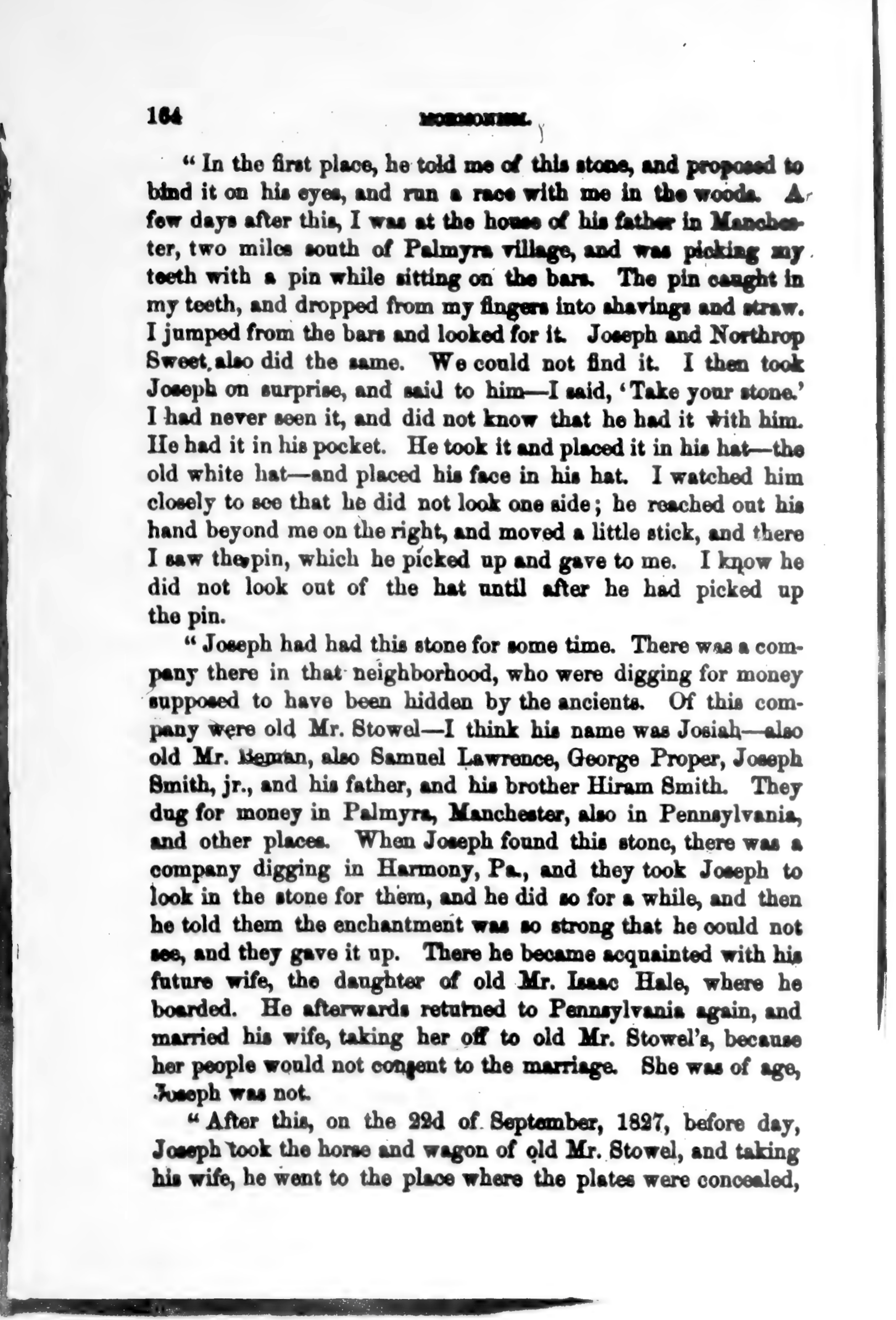
In the first place, he [Joseph Smith] told me of this stone, and proposed to bind it on his eyes, and run a race with me in the woods. A few days after this, I was at the house of his father in Manchester, two miles south of Palmyra village [New York], and was picking my teeth with a pin while sitting on the bars. The pin caught in my teeth, and dropped from my fingers into shavings and straw. I jumped from the bars and looked for it. Joseph and Northrop Sweet, also did the same. We could not find it. I then took Joseph on surprise, and said to him—I said, “Take your stone.” I had never seen it, and did not know that he had it with him. He had it in his pocket. He took it and placed it in his hat—the old white hat—and placed his face in his hat. I watched him closely to see that he did not look one side; he reached out his hand beyond me on the right, and moved a little stick, and there I saw the pin, which he picked up and gave to me. I know he did not look out of the hat until after he had picked up the pin.17
This is but one example of Smith using his stone to find lost items. Historian D. Michael Quinn gave the following summary of the Smith family’s involvement in magic:
Joseph Smith (founding prophet and president of the new church) had unquestionably participated in treasure-seeking and stone divination. Evidence indicates that he also used divining rods, a talisman, and implements of ritual magic. His father (one of the Eight Witnesses to the divinity of the Book of Mormon and later the church’s patriarch) had also participated in divining and the quest for treasure. His older brother Hyrum (another of the Eight Witnesses, a member of the First Presidency, and church patriarch after their father’s death) had also participated in the treasure-quest and was custodian of the family’s implements of ritual magic at his own death. His younger brothers Samuel and William (one of the Eight Witnesses and one of the original twelve apostles, respectively) accepted their brother’s stone divination and apparently joined some of Joseph’s treasure-expeditions. Understandably, they found nothing objectionable in other folk magic practices of their father and brothers.18
Quinn then goes on to enumerate the magic involvement of the rest of the witnesses:
The Three Witnesses to the Book of Mormon were likewise involved in folk magic. Oliver Cowdery was a rodsman before his 1829 meeting with Smith, who soon announced a revelation authorizing Cowdery to continue the revelatory use of his “rod of nature” . . . David Whitmer revered Smith’s use of a seer stone and may have possessed one of his own. Whitmer authorized a later spokesman for his own religious organization to obtain revelations through a stone . . . Martin Harris endorsed Smith’s use of a seer stone for divination and treasure-seeking. Before and after the discovery of the gold plates, Harris himself participated in treasuredigging and identified the Smith brothers Joseph and Hyrum as co-participants . . .
Of the remaining Eight Witnesses, Jacob Whitmer . . . had a seer stone which his descendants preserved . . . His brother-in-law Hiram Page . . . definitely had a stone of his own that he used for revelations . . . Christian, John, and Peter Whitmer Jr. were included in their pastor’s accusation of magic belief.19

A number of friends and relatives observed Smith as he dictated the Book of Mormon story to a scribe, all the while having his face buried in his hat as he stared at his magic stone. Smith’s father-in-law, Isaac Hale gave this description of the process:
The Manner in which he [Joseph] pretended to read and interpret, was the same as when he looked for the money-diggers, with the stone in his hat, and his hat over his face, while the Book of Plates were at the same time hid in the woods!20
When the plates were not hid in the woods they were laying off to one side, covered by a cloth. This leaves one wondering why God bothered preserving the plates if they were not necessary for the translation process? Furthermore, why preserve the Urim and Thummim for hundreds of years if a magic stone would work just as well? Since the plates were reportedly returned to the angel, there is no way for us to know if there really were any gold plates or whether the translation was correct. To counter this argument, Mormons often appeal to the statements made by Smith’s friends who claimed to see the plates. But did they see them through the “eye of faith” as some claimed or in a natural setting? Are these people to be believed?
The Witnesses
The Book of Mormon declared that after Joseph received the plates —
the book shall be hid from the eyes of the world, that the eyes of none shall behold it [the plates] save it be that three witnesses shall behold it, by the power of God, besides him [Joseph] to whom the book shall be delivered; and they shall testify to the truth of the book and the things therein. And there is none other which shall view it, save it be a few according to the will of God, to bear testimony of his word unto the children of men.21

At the front of the Book of Mormon are two statements by Smith’s friends and family attesting to his translation of the plates. In the first statement Oliver Cowdery, David Whitmer, and Martin Harris claimed that an angel of God showed the plates to them in a vision. The second statement is signed by eight men who claimed to see and heft the plates, although no angel is mentioned. This statement is signed by Christian Whitmer, Jacob Whitmer, Peter Whitmer, Jun., John Whitmer, Hiram Page, Joseph Smith, Sen. [Joseph’s father], Hyrum Smith and Samuel H. Smith [brothers of Smith].
The witnesses loosely fall into two groups—the Smith family and the Whitmer family. Oliver Cowdery, a third cousin of Joseph Smith, married David Whitmer’s sister, Elizabeth Ann. Hiram Page married another sister, Catherine Whitmer. Martin Harris does not fall into either group, being an established farmer in the area where the Smiths lived and the one who would end up financing the printing of the Book of Mormon.
| Smith Family | Whitmer Family |
|---|---|
| Joseph Smith, Jr. | David Whitmer |
| Joseph Smith, Sr. | Christian Whitmer |
| Hyrum Smith | Jacob Whitmer |
| Samuel H. Smith | Peter Whitmer, Jr. |
| Oliver Cowdery | Oliver Cowdery |
| John Whitmer | |
| Hiram Page |
Separate Visions
The testimony of the three witnesses leaves a person with the impression that they all saw the angel and the gold plates at the same time; however, such was not the case. In his History of the Church, Joseph Smith admits that Martin Harris was not with Whitmer and Cowdery when he saw the plates. Joseph had the three witnesses pray continually in an effort to obtain a view of the plates, but to no avail. Finally:
Upon this, our second failure, Martin Harris proposed that he should withdraw himself from us, believing, as he expressed himself, that his presence was the cause of our not obtaining what we wished for. He accordingly withdrew from us, and we knelt down again, . . . presently we beheld a light above us in the air, of exceeding brightness; and behold, an angel stood before us. In his hands he held the plates. . . .
I now left David and Oliver, and went in pursuit of Martin Harris. . . . We accordingly joined in prayer, and ultimately obtained our desires, for before we had yet finished, the same vision was opened to our view, at least it was again opened to me, whilst at the same moment, Martin Harris cried out, apparently in an ecstasy of joy, “‘Tis enough; ‘tis enough; mine eyes have beheld; mine eyes have beheld;” . . . 22
There seems to be some question as to the time that elapsed between the two visions. Joseph Smith would have us believe that Martin Harris’ vision occurred immediately after the other vision, but according to a reporter who interviewed David Whitmer, it was “a day or two after.”23 According to Anthony Metcalf, Martin Harris claimed that it was “about three days” later when he saw the plates.24
Mormon writer Marvin S. Hill commented:
. . . there is a possibility that the witnesses saw the plates in vision only. . . . There is testimony from several independent interviewers, all non-Mormon, that Martin Harris and David Whitmer said they saw the plates with their “spiritual eyes” only. . . . This is contradicted, however, by statements like that of David Whitmer in the Saints Herald in 1882, “these hands handled the plates, these eyes saw the angel.” But Z. H. Gurley elicited from Whitmer a not so positive response to the question,” did you touch them?” His answer was, “We did not touch nor handle the plates.” So far as the eight witnesses go, William Smith said his father never saw the plates except under a frock. And Stephen Burnett quotes Martin Harris that “the eight witnesses never saw them. . . .” Yet John Whitmer told Wilhelm Paulson . . . that he saw the plates when they were not covered, and he turned the leaves.25
Stephen Burnett, an early Mormon convert, heard Martin Harris speak in 1838, where Harris admitted the witnesses did not physically handle the plates, which led Burnett to renounce all of Mormonism. In April of 1838 he wrote a letter to Lyman E. Johnson explaining his decision:
. . . when I came to hear Martin Harris state in
apubliccongregationthat he never saw the plates with his natural eyes only in vision or imagination, neither Oliver [Cowdery] nor David [Whitmer] & also that the eight witnesses never saw them & hesitated to sign that instrument for that reason, but were persuaded to do it, the last pedestal gave way, in my view our foundation was sapped & the entire superstructure fell in heap of ruins, I therefore three week[s] since in the Stone Chapel gave a full history of the church since I became acquainted with it, the false preaching & prophecying etc of Joseph [Smith] together with the reasons why I took the course which I was resolved to do, and renounced the Book of Mormon . . . after we were done speaking M[artin] Harris arose & said he was sorry for any man who rejected the Book of Mormon for he knew it was true, he said he had hefted the plates repeatedly in a box with only a tablecloth or a handkerchief over them, but he never saw them only as he saw a city through a mountain. And said that he never should have told that the testimony of the eight [witnesses] was false, if it had not been picked out of [h]im but should have let it passed as it was . . . I am well satisfied for myself that if the witnesses whose names are attached to the Book of Mormon never saw the plates as Martin [Harris] admits that there can be nothing brought to prove that any such thing ever existed . . . 26

According to Martin Harris, the witnesses only hefted the plates, while stored in a sack, and did not view them with the naked eye.
Left To Doubt?
The LDS Church claims that the witnesses to the Book of Mormon never denied their testimony. There are, however, at least two statements in Mormon publications which indicate that the witnesses had doubts. In 1859, Brigham Young, the second president of the LDS Church, stated:
Some of the witnesses of the Book of Mormon, who handled the plates and conversed with the angels of God, were afterwards left to doubt and to disbelieve that they had ever seen an angel.27
There is evidence to indicate that Oliver Cowdery, one of the three witnesses, may have had doubts about his testimony. The following appeared in a poem that was published in the Mormon publication Times and Seasons in 1841:
Or does it prove there is no time,
Because some watches will not go?
. . .
Or prove that Christ was not the Lord
Because that Peter cursed and swore?
Or Book of Mormon not His word
Because denied, by Oliver?28
Reliable Men?
LDS Apostle John A. Widtsoe said that the eleven men who testified to the truthfulness of the Book of Mormon had “spotless reputations.” Non-Mormons, on the other hand, have made many serious charges against the witnesses. Some of the most damaging statements against the Book of Mormon witnesses, however, came from the pen of Joseph Smith and other early Mormon leaders.
In fact, after Martin lost the first 116 pages of the Book of Mormon manuscript, Joseph Smith gave a revelation in July of 1828 in which Martin Harris was called a “wicked man,” who “has set at naught the counsels of God, and has broken the most sacred promises” (Doctrine and Covenants 3:12-13). In another revelation given sometime later, God was supposed to have told Joseph Smith that Harris “is a wicked man, for he has sought to take away the things wherewith you have been entrusted; and he has also sought to destroy your gift” (D&C 10:7).
Trouble in Missouri and Ohio
Although Joseph Smith was able to prevail against the revelations from Hiram Page’s peep stone, more serious problems were developing in the late 1830’s in the Mormon settlements in Far West, Missouri and Kirtland, Ohio.
After the Mormons were driven from Independence, Missouri, in the early 1830’s, Smith instructed the church members not to sell their property with the hope that they could still reclaim the land. However, David Whitmer and Oliver Cowdery went against this edict. Kenneth Winn explained:
Cowdery was particularly nettled over the church’s presuming to dictate how he used his property. . . . The dissenters’ avowal that their individual freedom should take precedence over the judgment of church authorities made active conflict inevitable. Nor was it long in coming. In January [1838], against policy, William Phelps, Oliver Cowdery, and David Whitmer sold their land in Jackson County. . . . Accordingly, on April 12, the Missouri High Council charged David and John Whitmer, Oliver Cowdery, and Lyman Johnson with various counts of dereliction of duty, violation of church policy, and disrespect for the church leadership and cut them off from the church.29

A 3-dollar note from Joseph Smith’s “Kirtland Anti-Banking Co.”
In Kirtland, Ohio, Joseph Smith and the leaders had become embroiled in land speculation, borrowing large amounts of money and starting their own bank.30
When the bank failed, the economy collapsed and the creditors started demanding payment, many lost faith in Joseph’s prophetic leadership. Apostle George A. Smith related the following:
After the organization of the Twelve Apostles, the spirit of apostacy became more general. . . . One of the First Presidency, several of the Twelve Apostles, High Council, Presidents of Seventies, the witnesses of the Book of Mormon, Presidents of Far West, and a number of others standing high in the Church were all carried away in this apostacy . . . 31
While George A. Smith didn’t specify the names of the witnesses, we know that Martin Harris, David Whitmer and Oliver Cowdery had all left the LDS Church by 1838. In fact, the LDS leaders published an attack on the character of Martin Harris in The Elders’ Journal, a Mormon publication edited by Joseph Smith. The article charged that Harris and others were guilty of “swearing, lying, cheating, swindling, drinking, with every species of debauchery.”32 Martin Harris, in turn, accused Joseph Smith of “lying and licentiousness.”33
In a letter dated December 16, 1838, Joseph Smith said that “John Whitmer, David Whitmer, Oliver Cowdery, and Martin Harris are too mean to mention.”34 Smith specifically singled out David Whitmer:
God suffered such kind of beings to afflict Job. . . . This poor man [William E. McLellin] who professes to be much of a prophet, has no other dumb ass to ride but David Whitmer, to forbid his madness when he goes up to curse Israel; and this ass not being of the same kind as Balaam’s, . . . he brays out cursings instead of blessings. Poor ass!35
Before driving the dissenters from Far West, Missouri, the Mormons wrote them a very threatening letter. In this letter the dissenters were accused of stealing, lying and counterfeiting:
Whereas the citizens of Caldwell county have borne with the abuse received from you at different times, . . . until it is no longer to be endured; . . . out of the county you shall go, . . . depart, depart, or a more fatal calamity shall befall you.
After Oliver Cowdery had been taken by a State warrant for stealing, and the stolen property found . . . in which nefarious transaction John Whitmer had also participated. Oliver Cowdery stole the property, conveyed it to John Whitmer . . . Oliver Cowdery, David Whitmer, and Lyman E. Johnson, united with a gang of counterfeiters, thieves, liars, and blacklegs of the deepest dye, to deceive, cheat, and defraud the saints out of their property. . . .
During the full career of Oliver Cowdery and David Whitmer’s bogus money business, it got abroad into the world that they were engaged in it. . . . We have evidence of a very strong character that you are at this very time engaged with a gang of counterfeiters, coiners, and blacklegs, . . . we will put you from the county of Caldwell: so help us God.36
The dissenters, fearing for their lives, fled Far West, leaving their families behind. Fawn Brodie tells of their hardship:
Upon receiving this ultimatum the two Whitmers, with Oliver Cowdery and Lyman Johnson, set out for Clay County to hire a gentile lawyer. When they returned from Liberty, they met their families on the road, bearing a tale of Danite [a secret Mormon vigilante group] persecution that the men could not believe possible as coming from their former brethren. The Danites had surrounded their homes, ordered their wives to pack their blankets and leave the county immediately, and threatened death to anyone who returned to Far West. They had been robbed, according to John Whitmer, of all their goods save bedding and clothes.37
Writing in 1887, David Whitmer explained why he had left the church:
If you believe my testimony to the Book of Mormon; if you believe that God spake to us three witnesses by his own voice, then I tell you that in June, 1838, God spake to me again by his own voice from the heavens, and told me to “separate myself from among the Latter Day Saints, for as they sought to do unto me, so should it be done unto them.”
In the spring of 1838, the heads of the church and many of the members had gone deep into error and blindness. . . . About the same time that I came out, the Spirit of God moved upon quite a number of the brethren who came out, with their families, all of the eight witnesses who were then living (except the three Smiths) came out; Peter and Christian Whitmer were dead. Oliver Cowdery came out also. Martin Harris was then in Ohio. The church went deeper and deeper into wickedness.38
Cowdery a Counterfeiter?
In the “Far West Record,” an early LDS ledger containing minutes of various church meetings, is some very important information concerning Oliver Cowdery and the bogus money business. After examining the record, LDS scholar Leland Gentry wrote:
[Fredrick G.] Williams, . . . testified that Oliver [Cowdery] had personally informed him of a man in the church by the name of Davis who could compound metal and make dies which could not be detected from the real thing. Oliver allegedly told Williams that there was no harm in accepting and passing around such money, provided it could not be determined to be unsound.
Joseph Smith’s testimony was similar. He claimed that a nonmember of the Church by the name of Sapham had told him in Kirtland that a warrant had been issued against Oliver “for being engaged in making a purchase of bogus money and dies to make the counterfeit money with.” According to Smith, he and Sidney Rigdon went to visit Oliver concerning the matter and told him that if he were guilty, he had better leave town; but if he was innocent, he should stand trial and thus be acquitted. “That night or next,” the Prophet said, Oliver “left the country.”39
From this information it would appear that Joseph Smith was complicit in that he warned Oliver Cowdery to flee from the law if he was guilty.
When Oliver Cowdery was excommunicated from the LDS Church in 1838, one of the charges against him was:
For seeking to destroy the character of President Joseph Smith Jr by falsely insinuating that he was guilty of adultery &c.40
An example of Cowdery’s accusations against Smith is his 1838 letter to his brother, Warren, charging Smith with having an affair with his teenage housekeeper while in Kirtland, Ohio, in the mid-1830’s:
When he [Joseph Smith] was there we had some conversation in which in every instance I did not fail to affirm that what I had said was strictly true. A dirty, nasty, filthy affair of his and Fanny Alger’s was talked over in which I strictly declared that I had never deserted from the truth in the matter, and as I supposed was admitted by himself.41

The eighth charge against Cowdery read as follows: “For disgracing the Church by being connected in the bogus business, as common report says.”42 Mormon scholar Leland Gentry states: “Joseph Smith, for example, testified that Cowdery had informed him that he had ‘come to the conclusion to get property, and that if he could not get it one way, he would get it another, God or no God, Devil or no Devil, property he must and would have.’”43
Since six of the nine charges against Cowdery were sustained, he was “considered no longer a member of the Church of Jesus Christ of Latter-day Saints.”44 If the charges against Cowdery were true, he certainly does not present a picture of someone to trust. If the charges against him were trumped up or exaggerated, it doesn’t speak well for Joseph Smith’s character.
Cowdery Joins the Methodists
After separating himself from the Mormons, Oliver Cowdery became a member of the “Methodist Protestant Church of Tiffin, Seneca County, Ohio.” C. J. Keen, a lay leader in the Methodist Church, gave an affidavit in which he stated:
. . . Mr. Cowdery expressed a desire to associate himself with a Methodist Protestant Church of this city. . . . he was unanimously admitted a member thereof.
At that time he arose and addressed the audience present, admitted his error and implored forgiveness, and said he was sorry and ashamed of his connection with Mormonism.
He continued his membership while he resided in Tiffin, and became superintendent of the Sabbath School, and led an exemplary life while he resided with us.45
Mormon writer Richard L. Anderson admits that Cowdery joined the Methodists:
The cessation of his activity in the Church meant a suspension of his role as a witness of the Book of Mormon. Not that his conviction ceased, but he discontinued public testimony as he worked out a successful legal and political career in non-Mormon society . . . he logically affiliated himself with a Christian congregation for a time, the Methodist Protestant Church at Tiffin, Ohio.46
It should be noted that the poem about Oliver Cowdery denying his testimony to the Book of Mormon appeared in the Mormon publication Times and Seasons around the same time that Cowdery renounced Mormonism and joined the Methodist Church at Tiffin, Ohio.
Following James Jesse Strang
After Smith’s death there was dissention in the church regarding church leadership. James Jesse Strang, like Joseph Smith, claimed that he found ancient brass plates that he translated with his own Urim and Thummim. He also produced witnesses who swore they saw his plates, and their testimony is recorded in his book in almost the same way as that the witnesses in the Book of Mormon. Some of the Book of Mormon witnesses were influenced by the claims of James Jesse Strang as Smith’s successor. Brigham Young and the other Mormon leaders denounced Strang as an impostor, but four of the Book of Mormon witnesses joined the Strangite movement. On January 20, 1848, James J. Strang wrote the following:
. . . early in 1846 the tract reprint of the first number of the Voree Herald [Wisconsin], containing the evidence of my calling and authority, strayed into upper Missouri. Immediately I received a letter from Hiram Page, one of the witnesses of the Book of Mormon, and a neighbor and friend to the Whitmers’ who lived near him, and that they rejoiced with exceeding joy that God had raised up one to stand in place of Joseph. . . . He [Hiram Page] goes on to say that all the witnesses of the Book of Mormon living in that region received the news with gladness, and finally that they held a council in which David and John Whitmer and this Hiram Page were the principal actors; and being at a loss what they ought to do about coming to Voree, sent up to me as a prophet of God to tell them what to do. . . . last April (1847) I received another letter from the same Hiram Page, acknowledging the receipt of mine . . . and giving me the acts of another council of himself at the Whitmers’, . . . they invite me to come to their residence in Missouri and receive from them, David and John Whitmer, church records, and manuscript revelations, which they had kept in their possession from the time that they were active members of the church. These documents they speak of as great importance to the church, and offer them to me as the true shepherd who has a right to them . . .47
James Jesse Strang

In a letter to David Whitmer, dated December 2, 1846, William E. McLellin said that James J. Strang “told me that all the witnesses to the book of Mormon yet alive were with him, except Oliver [Cowdery].”48 John Whitmer, David’s brother, wrote the following in his history of the church which later, however, was crossed out:
God knowing all things prepared a man whom he visited by an angel of God and showed him where there were some ancient record hid, . . . whose name is James J. Strang. . . . and Strang Reigns in the place of Smith the author and proprietor of the Book of Mormon.49
Martin Harris joined the Strangite movement and even went on a mission to England for the Strangites. The LDS Church’s own publication Latter-Day Saints’ Millennial Star had a great deal to say about Martin Harris when he arrived in England:
One of the witnesses to the Book of Mormon, yielded to the spirit and temptation of the devil a number of years ago—turned against Joseph Smith and became his bitter enemy. He was filled with the rage and madness of a demon. One day he would be one thing, and another day another thing. He soon became partially deranged or shattered, as many believed, flying from one thing to another. . . . In one of his fits of monomania, he went and joined the “Shakers” or followers of Anna Lee. . . . but since Strang has made his entry . . . Martin [Harris] leaves the “Shakers,” whom he knows to be right, . . . and joins Strang. . . . We understand that he is appointed a mission to this country, . . . if the Saints wish to know what the Lord hath said to him they may turn to . . . the Book of Doctrine and Covenants, and the person there called a “wicked man” is no other than Martin Harris . . . Elder Wheelock will remember that evil men, like Harris, out of the evil treasure of their hearts bring forth evil things. . . .
Just as our paper was going to press, we learned that Martin Harris, about whom we have written in another article, had landed in Liverpool, . . . there was a strangeness about him, and about one or two who came with him . . . A lying deceptive spirit attends them, and has from the beginning. . . . they know that they are of their father, the devil, who was a liar from the beginning, and abode not in the truth.50
Although the Book of Mormon witnesses were attracted to Strang for a short time, they soon became interested in a movement started by former apostle William E. McLellin.
William E. McLellin
Five of the Book of Mormon witnesses definitely supported McLellin’s movement and another gave some encouragement to it. One of McLellin’s claims was that David Whitmer was the rightful successor to Smith, not Brigham Young. Martin Harris was baptized into the McLellin movement and even joined with Leonard Rich and Calvin Beebe in a “Testimony of Three Witnesses” that Joseph Smith ordained David Whitmer to be his “Successor in office.”51

The Mormons who went to Utah felt, of course, that Brigham Young was to be leader of the church. On July 28, 1847, Oliver Cowdery wrote a letter to David Whitmer in which he gave support to McLellin’s ideas and told Whitmer that “our right gives us the head.” In a letter dated September 8, 1847, David Whitmer wrote to Oliver Cowdery and told him that “it is the will of God that you be one of my counsellors in the presidency of the Church. Jacob and Hiram have been ordained High Priests . . .”52
William E. McLellin recounted how David Whitmer gave revelations supporting his organization and condemned the Mormon Church:
. . . after a few moments of solemn secret prayer, the following was delivered solely through and by David Whitmer, as the Revelator, and written by me as scribe, viz: “Verily, verily thus saith the Lord unto my servants David, and John, and William, and Jacob, and Hiram, . . . Behold I have looked upon you from the beginning, and have seen that in your hearts dwelt truth, and righteoness [sic]. . . . it must needs have been that ye were cast out from among those who had polluted themselves and the holy authority of their priesthood. . . . For verily, verily saith the Lord, even Jesus, your Redeemer, they have polluted my name, and have done continually wickedness in my sight, . . . Thou shalt write concerning the downfall of those who once composed my church . . .”
But here David [Whitmer] said a vision opened before him, and the spirit which was upon him bid him stop and talk to me concerning it. He said that in the bright light before him he saw a small chest or box of very curious and fine workmanship, which seemed to be locked, but he was told that it contained precious things, I was told that it contained “the treasure of wisdom, and knowledge from God.” . . . David and I turned aside, and called upon the Lord, and received direct instruction how we should further proceed. . . . I ordained H. Page to the office of High Priest, . . . we two ordained Jacob Whitmer to the same office. Then we all laid hands on John Whitmer and re-ordained him . . . we stepped forward and all laid hands upon David and re-ordained him . . . 53
McLellin’s movement never really got off the ground, and later in his life David Whitmer was reluctant to talk about his association with McLellin. In 1849 Hiram Page, David Whitmer’s brother-in-law and one of the eight witnesses, renounced the McLellin movement. Richard P. Howard explains:
McLellin’s flagging hope for David Whitmer’s seership vanished as he read, published in the August issue of the Olive Branch—the periodical of the James C. Brewster-Hazen Aldrich Church of Christ also at Kirtland—Hiram Page’s letter of 24 June 1849. Page speaking for himself and his Whitmer relatives in Richmond, renounced what was of value to McLellin from the proceedings of the “conference” of September 1847. Page acknowledged McLellin’s honorable motives in trying to affirm the Whitmers as good and honest people. The Whitmers, however, took exception to McLellin’s claim of direction by the Holy Spirit in coming there and insisting that they organize in some church capacity. Page saw through to the center of McLellin’s thinking that the church “must come through him, which would give a sanction to all that he had done, which would give a more speedy rise to the cause. . . . But we had not as yet come to an understanding, but consented to the organization after three days successive entreaties. Now we acknowledge that the organization was not in accordance with the order of the Gospel Church.”54
If David Whitmer could give a revelation in the McLellin group, which Mormons would not accept and Whitmer eventually abandoned, on what basis should we accept his earlier claim of a vision regarding the Book of Mormon?
Since a person who is investigating the Book of Mormon has only the testimony of eleven men to rely on, he should be certain that they were trustworthy men. If the Book of Mormon witnesses were honest, stable and not easily influenced by men, we would be impressed by their testimony. Unfortunately, however, we find that this is not the case. The evidence shows that in matters relating to religion they were gullible and easily misled.
Since the testimony of the three witnesses who claimed to see the angel is especially important, we want to summarize the information we have on their character.
The Three Witnesses Summarized

Martin Harris
Martin Harris was very unstable in his religious life. G. W. Stodard, a resident of Palmyra, made this statement in an affidavit dated November 28, 1833:
I have been acquainted with Martin Harris, about thirty years. As a farmer, he was industrious and enterprising. . . . Although he possessed wealth, his moral and religious character was such, as not to entitle him to respect among his neighbors. . . . He was first an orthadox [sic] Quaker, then a Universalist, next a Restorationer, then a Baptist, next a Presbyterian, and then a Mormon.55
Martin Harris’ instability certainly did not cease when he joined the Mormon church. The Mormons themselves recorded that Harris “became partially deranged . . . flying from one thing to another.”56 Mormon writer Richard L. Anderson admits that Martin Harris “changed his religious position eight times” during the period when he was in Kirtland, Ohio:
The foregoing tendencies explain the spiritual wanderlust that afflicted the solitary witness at Kirtland. In this period of his life he changed his religious position eight times, including a rebaptism by a Nauvoo missionary in 1842. Every affiliation of Martin Harris was with some Mormon group, except when he was affiliated with the Shaker belief, a position not basically contrary to his Book of Mormon testimony because the foundation of that movement was acceptance of personal revelation from heavenly beings.57
If we add the “eight times” that Martin Harris changed his religious position in Kirtland to the five changes he made before, we find that he changed his mind thirteen times!
Mormon writer E. Cecil McGavin stated:
Martin Harris was an un-aggressive, vacillating, easily influenced person who was no more pugnacious than a rabbit. . . . His conviction of one day might vanish and be replaced by doubt and fear before the setting of the sun. He was changeable, fickle, and puerile in his judgment and conduct.58
After changing his mind about religion many times, Martin Harris returned to the Mormon church. There is evidence to show, however, that he was still not satisfied. Anthony Metcalf claimed Martin Harris told him that he “never believed that the Brighamite branch of the Mormon church, nor the Josephite church, was right, because in his opinion, God had rejected them,” and he took his endowments in Salt Lake City, only to find out “what was going on in there.”59
Joseph Smith’s own revelations referred to Harris as a “wicked man,” and the church’s publication Millennial Star said that he was an “evil” man and that “a lying deceptive spirit” attended him and his friends.
The Mormons themselves said that Harris had “fits of monomania.” Harris’ wife made some very serious charges against his character, but they are actually not much worse than those made by the Mormons. Mrs. Harris stated that Martin had “mad-fits.” The Mormons said that when he left the church he “was filled with the rage and madness of a demon.” She stated that Martin was a liar. The Mormons admitted that when he came to England “a lying deceptive spirit” attended him. She stated that Mormonism had made him “more cross, turbulent and abusive to me.” Joseph Smith himself later classified Martin Harris as one of those who was “too mean to mention.”

Oliver Cowdery
Oliver Cowdery was involved in rod-working even before meeting Smith. He also believed in magic seer stones. According to Joseph Smith, Cowdery was led astray by Hiram Page’s “peep-stone.”
After he was excommunicated from the Mormon church he united with the “Methodist Protestant Church” at Tiffin, Ohio. As mentioned previously, the Mormons published a poem in 1841 which stated that the Book of Mormon was “denied” by Oliver. He accused Joseph Smith of adultery while the Mormons, on the other hand, claimed that Oliver “committed adultery.” Joseph Smith listed Cowdery among those who were “too mean to mention” and the Mormons claimed that he joined “a gang of counterfeiters, thieves, liars, and blacklegs.” Joseph Smith testified that when a warrant was issued against Cowdery for “being engaged in making a purchase of bogus money and dies,” he “left the country.”
While Cowdery returned to the LDS Church before his death, David Whitmer claimed that Cowdery died believing Joseph Smith was a fallen prophet and that his revelations in the Doctrine and Covenants must be rejected:
I did not say that Oliver Cowdery and John Whitmer had not endorsed the Doctrine and Covenants in 1836. They did endorse it in 1836; I stated that they “came out of their errors (discarded the Doctrine and Covenants), repented of them, and died believing as I do to-day,” and I have the proof to verify my statement. If any one chooses to doubt my word, let them come to my home in Richmond and be satisfied. In the winter of 1848, after Oliver Cowdery had been baptized at Council Bluffs, he came back to Richmond to live. . . . Now, in 1849 the Lord saw fit to manifest unto John Whitmer, Oliver Cowdery and myself nearly all the errors in doctrine into which we had been led by the heads of the old church. We were shown that the Book of Doctrine and Covenants contained many doctrines of error, and that it must be laid aside. . . . They were led out of their errors, and are upon record to this effect, rejecting the Book of Doctrine and Covenants.60

David Whitmer
David Whitmer was also very gullible. He was influenced by Hiram Page’s “peep-stone,” and possibly by a woman with a “black stone” in Kirtland, Ohio. Joseph Smith identified David Whitmer with those who were “too mean to mention,” and called him a “dumb ass.” The Mormons also accused Whitmer of joining with a “gang of counterfeiters, thieves, liars, and blacklegs.”61
David Whitmer evidently supported James J. Strang for awhile, then changed his mind and joined the McLellin group, where he was to be the prophet and head. He even gave a revelation in which the Lord was supposed to have told him the Mormons “polluted my name, and have done continually wickedness in my sight.” Yet he left the McLellin movement, leaving one to question the source of his revelation.
David Whitmer never returned to the LDS Church. Toward the end of his life he was a member of the “Church of Christ”—another small group which believed in the Book of Mormon. Just before his death, Whitmer published two different pamphlets, An Address to All Believers in Christ and An Address to Believers in the Book of Mormon, in which he reaffirmed his rejection of all things Mormon outside of the Book of Mormon.62
Apostle John A. Widtsoe said that the Book of Mormon plates were seen and handled “by eleven competent men, of independent minds and spotless reputations.” We feel, however, that these witnesses were easily influenced by men, given to magic and visions, vacillating in their stories and therefore were not competent witnesses. Some of them even gave false revelations in the name of the Lord. Mormons ask us to accept David Whitmer’s testimony to the Book of Mormon, but will they accept Whitmer’s revelations which he gave when he was with the McLellin group? Certainly not. Neither will they accept his statement that “God spake to me again by His own voice from the heavens, and told me to ‘separate myself from among the Latter Day Saints.’”
It would appear that the witnesses to the Book of Mormon would follow almost anyone who had a seer stone or claimed to have been visited by an angel. Take for instance their willingness to believe in James J. Strang who claimed to translate ancient plates with his Urim and Thummim. The reader will remember that Martin Harris even served on a mission for the Strangites. This was not the only time that Harris endorsed a religion which claimed to have a sacred book given directly by the Lord. As we have already shown, in the Millennial Star the Mormons admitted that Martin Harris joined the Shakers: “In one of his fits of monomania, he went and joined the ‘Shakers’ or followers of Anne Lee.”
The Shakers
The Shakers felt that “Christ has made his second appearance on earth, in a chosen female known by the name of Ann Lee, and acknowledged by us as our Blessed Mother in the work of redemption.”63

The Shakers, of course, did not believe the Book of Mormon, but they had a book entitled A Holy, Sacred and Divine Roll and Book; From the Lord God of Heaven, to the Inhabitants of Earth. More than sixty individuals gave testimony to the Sacred Roll and Book, which was published in 1843. Although not all of them mention angels appearing, some of them tell of many angels visiting them—one woman told of eight different visions. On page 304 of this book, we find the testimony of eight witnesses:
We, the undersigned, hereby testify, that we saw the holy Angel standing upon the house-top, as mentioned in the foregoing declaration, holding the Roll and Book.
Betsey Boothe.
Louisa Chamberlain.
Caty De Witt.
Laura Ann Jacobs.Sarah Maria Lewis.
Sarah Ann Spencer.
Lucinda McDoniels.
Maria Hedrick.
Joseph Smith only had three witnesses who claimed to see an angel. The Shakers, however, had a large number of witnesses who claimed they saw angels and the Roll and Book. There are over a hundred pages of testimony from “Living Witnesses.” The evidence indicates that Martin Harris accepted the Sacred Roll and Book as a divine revelation. Non-Mormon Clark Braden stated: “Harris declared repeatedly that he had as much evidence for a Shaker book he had as for the Book of Mormon.”64
Mormons have also conceded that Martin Harris believed in the Shaker book. In a thesis written at Brigham Young University, Wayne Cutler Gunnell stated that on December 31, 1844, “Phineas H. Young [Brigham Young’s brother] and other leaders of the Kirtland organization” wrote a letter to Brigham Young in which they stated: “There are in this place all kinds of teaching; Martin Harris is a firm believer in Shakerism, says his testimony is greater than it was of the Book of Mormon.”65
The fact that Martin Harris would even join such a group shows that he was unstable and easily influenced. Therefore, his testimony that the Book of Mormon was of divine origin should not be relied upon. How can anyone put their trust in men who were constantly following after movements like the Shakers, Strangites, and the McLellin group? The Book of Mormon witnesses when “weighed in the balances” are found wanting.
Other Visions
Besides the angel that appeared to the three witnesses to the Book of Mormon, there were many other occasions in the history of Mormonism when angels were supposed to have appeared.
Joseph Smith declared on March 27, 1836, that the Kirtland Temple was “filled with angels.”66 Under the date of March 30, 1836, the following appears in Joseph Smith’s history: “The Savior made his appearance to some, while angels ministered to others, . . . the occurrences of this day shall be handed down upon the pages of sacred history, to all generations; as the day of Pentecost, so shall this day be numbered and celebrated as a year of jubilee . . .”67
Joseph Smith claimed that he and Oliver Cowdery saw Moses, Elias, Elijah and the Lord in the Kirtland Temple (see Doctrine and Covenants, sec. 110). If a person reads only Joseph Smith’s account of this “endowment” he is apt to be very impressed. William E. McLellin, however, gives an entirely different story. He claims that there was “no endowment.”68 It should be remembered that McLellin was one of the Twelve Apostles at the time the endowment was supposed to have been given. On page seven of the Ensign of Liberty, McLellin joined with five others in stating that “the anticipated endowment” was “a failure!!” In fact, a reporter for the Des Moines Daily News stated that David Whitmer absolutely denied the manifestations in the temple:
The great heavenly “visitation,” which was alleged to have taken place in the temple at Nauvoo, was a grand fizzle. The elders were assembled on the appointed day, which was promised would be a veritable day of Pentecost, but there was no visitation. No Peter, James and John; no Moses and Elias, put in an appearance. “I was in my seat on that occasion,” says Mr. Whitmer, “and I know that the story sensationally circulated, and which is now on the records of the Utah Mormons as an actual happening, was nothing but a trumped up yarn . . . ”69
When we look at the testimony of the three witnesses to the Book of Mormon or the report of happenings in the Kirtland temple we must remember that many early Mormons were given to visions. Apostle George A. Smith made this statement concerning an incident in the Kirtland temple: “Sylvester Smith bore testimony of seeing the hosts of heaven and the horsemen. In his exertion and excitement it seemed as though he would jump through the ceiling.”70
John Whitmer, one of the eight witnesses and church historian in the 1830’s, related the following concerning some of the visions that members of the church had in Kirtland, Ohio:
For a perpetual memory, to the shame and confusion of the Devil, permit me to say a few things respecting the proceedings of some of those who were disciples, and some remain among us, and will, and have come from under the error and enthusiasm which they had fallen.
Some had visions and could not tell what they saw. Some would fancy to themselves that they had the sword of Laban, and would wield it as expert as a light dragon; some would act like an Indian in the act of scalping; some would slide or scoot on the floor with the rapidity of a serpent, which they termed sailing in the boat to the Lamanites, preaching the gospel. And many other vain and foolish maneuvers that are unseeming and unprofitable to mention. Thus the Devil blinded the eyes of some good and honest disciples.71
It seems that the early Mormons could see almost anything in vision. John Pulsipher recorded the following in his journal:
One pleasant day in March, while I was at work in the woods, about one mile from the Temple, . . . there was a steamboat past [sic] over Kirtland in the air! . . . It passed right along and soon went out of our hearing. When it got down to the city it was seen by a number of persons. . . . Old Elder Beamon, who had died a few months before was seen standing in the bow of the Boat. . . . The boat went steady along over the city passed right over the Temple and went out of sight to the west!72
Seer Stones in the Celestial Kingdom
Unlike reports of visions, the mention of seer stones became fewer after the Mormons moved from New York. However, Smith seemed to envision their use in the afterlife. In 1843 Joseph Smith wrote:
Doctrine and Covenants 130:6-11
6 The angels do not reside on a planet like this earth;
7 But they reside in the presence of God, on a globe like a sea of glass and fire, where all things for their glory are manifest, past, present, and future, and are continually before the Lord.
8 The place where God resides is a great Urim and Thummim.
9 This earth, in its sanctified and immortal state, will be made like unto crystal and will be a Urim and Thummim to the inhabitants who dwell thereon, whereby all things pertaining to an inferior kingdom, or all kingdoms of a lower order, will be manifest to those who dwell on it; and this earth will be Christ’s.
10 Then the white stone mentioned in Revelation 2:17, will become a Urim and Thummim to each individual who receives one, whereby things pertaining to a higher order of kingdoms will be made known;
11 And a white stone is given to each of those who come into the celestial kingdom, whereon is a new name written, which no man knoweth save he that receiveth it. The new name is the key word.
Brigham Young related a conversation he had with Joseph Smith regarding seer stones:
I met with the Twelve at brother Joseph’s. He conversed with us in a familiar manner . . . and explained to us the Urim and Thummim. . . . He [Joseph] said that every man who lived on the earth was entitled to a seer stone, and should have one, but they are kept from them in consequence of their wickedness, and most of them who do find one make an evil use of it: he showed us his seer stone.73
Seer stones remained popular with the Mormons even into the Utah period. Historian D. Michael Quinn explained:
In 1860 Young also preached “that the gift of seeing was a natural gift, that there are thousands in the world who are natural born Seers.” [Deseret News—Weekly, Dec. 26, 1860] Shortly after publication of a summary of this sermon, Apostle John Taylor explained to a church congregation the meaning of Young’s remarks in regard to seer stones and church authority: “Brigham Young in saying that He did not profess to be a prophet [,] seer & Revelator as Joseph Smith was, was speaking of men being born Natural Prophets & Seers. Many have the gift of seeing through seer stones without the Priesthood at all. He [Young] had not this gift [of using seer stones] naturally yet He was an Apostle & the Preside[n]t of the Church & Kingdom of God on the Earth . . . ” With such statements from church leaders, it is understandable why many Mormon pioneers exercised “this gift” of using seer stones.74
Conclusion
When one reads of the involvement with magic objects by Joseph Smith and the Book of Mormon witnesses, plus charges and counter-charges of wrong doing and visions in various early splinter groups, one is left to wonder about the credibility of their religious experiences. Dan Vogel observed:
The real question is not the trustworthiness of the witnesses but whether testimony resulting from visions or hallucinations is reliable. Indeed, does the testimony of the Book of Mormon witnesses merit greater attention than that of other similar religious testimony?75
Joseph Smith was certainly not the first to claim revelations or to bring forth a new book purporting to be scripture. For instance, the story of the coming forth of the Koran, the sacred scripture of Islam, bears some interesting parallels to Joseph Smith’s account of the origin of the Book of Mormon. N. J. Dawood, who translated the Koran into English, gave this information concerning its origin:
“For Muslims it is the infallible word of God, a transcript of a tablet preserved in heaven, revealed to the Prophet Mohammed by the Angel Gabriel. . . . According to Muslim tradition, one night in Ramadhan about the year 610 [A.D.], as he was asleep or in a trance, the Angel Gabriel came to him and said: ‘Recite!’ He replied: ‘What shall I recite?’ The order was repeated three times . . .
“The Koranic revelations followed each other at brief intervals and were at first committed to memory by professional remembrancers. During Mohammed’s life-time verses were written on palm-leaves, stones, and any material that came to hand. Their collection was completed during the caliphate of Omar, . . . ”76
Mohammed declared that he was God’s true prophet, appointed by an angel, and that he was restoring true religion to the earth. Twelve centuries later, the Mormon prophet Joseph Smith made a similar claim. When Mormons assert that they have had a spiritual experience that proves the truthfulness of Mormonism to them, they need to remember that many other faiths make similar claims. Even within the various splinter groups of Mormonism there are numerous assertions of visions. As Christians we must evaluate all such claims and test them in light of the evidence and what God has already revealed in the Bible.
Footnotes:
- Dan Vogel, ed., Early Mormon Documents (Salt Lake City: Signature Books, 1998), vol. 1, pp. 220-221. ↩︎
- For a detailed discussion of the problems associated with Smith’s claim of using the Urim and Thummim and the seer stone, see The Creation of the Book of Mormon: A Historical Inquiry, by LaMar Petersen, chapter 2. Also, D. Michael Quinn, Early Mormonism and the Magic World View (Salt Lake City: Signature Books, 1998), pp. 174-175, 243. ↩︎
- As cited in Early Mormon Documents, vol. 1, p. 532. ↩︎
- The Saints’ Herald, May 19, 1888, p. 310, as cited by Jerald and Sandra Tanner, The Changing World of Mormonism, (Chicago: Moody Press, 1981), p. 81. ↩︎
- Jerald and Sandra Tanner, Mormonism—Shadow or Reality? (Salt Lake City: Utah Lighthouse Ministry, 2008), pp. 32-49D. ↩︎
- Dan Vogel, ed., Early Mormon Documents (Salt Lake City: Signature Books, 1998), vol. 2, pp. 303-304. ↩︎
- As cited by H. Michael Marquardt, The Rise of Mormonism: 1816-1844, (Longwood, FL: Xulon Press, 2005), p. 68. ↩︎
- Jerald and Sandra Tanner, Mormonism, Magic and Masonry (Salt Lake City: Utah Lighthouse Ministry, 1988), pp. 2-5. ↩︎
- As cited in Mormonism, Magic and Masonry, p. 2. See also Early Mormonism and the Magic World View, chapter 3. ↩︎
- Pearson H. Corbett, Hyrum Smith—Patriarch, p. 453, as cited in Mormonism, Magic and Masonry, p. 5. ↩︎
- Quinn, Early Mormonism and the Magic World View, p. 104. ↩︎
- As cited in Early Mormon Documents, vol. 1, p. 285. ↩︎
- Quinn, Early Mormonism and the Magic World View, pp. 245-246. ↩︎
- Cowdery’s father, William, was a noted rodsman in Vermont. See Early Mormonism and the Magic World View, p. 35. ↩︎
- Quinn, Early Mormonism and the Magic World View, pp. 35-39. ↩︎
- Joseph Smith, History of the Church (Salt Lake City: Deseret Book, 1976), vol. 1, pp. 109-110. ↩︎
- Joel Tiffany, ed., Tiffany’s Monthly, (May 1859): p. 164. ↩︎
- Quinn, Early Mormonism and the Magic World View, p. 240. ↩︎
- Ibid. ↩︎
- E. D. Howe, Mormonism Unvailed (Painesville, Ohio, 1834), p. 265. ↩︎
- Book of Mormon, 2 Nephi 27:12-13. ↩︎
- Smith, History of the Church, vol. 1, pp. 54-55. ↩︎
- George Reynolds, The Myth of the Manuscript Found (Salt Lake City: Juvenile Instructor Office, 1883), p. 83. ↩︎
- Anthony Metcalf, Ten Years Before the Mast (Malad City, In., 1888), pp. 70-71. ↩︎
- Marvin S. Hill, “Brodie Revisited: A Reappraisal,” Dialogue: A Journal of Mormon Thought, (Winter, 1972): pp. 83-84. ↩︎
- Vogel, Early Mormon Documents, vol. 2, pp. 291-292. Also online at The Joseph Smith Papers site: JS Letterbook 2 (1829—ca. summer 1843), p. 64. ↩︎
- Brigham Young, Journal of Discourses (June 5, 1859) vol. 7, p. 164. ↩︎
- Times and Seasons, Nauvoo, Illinois (July 15, 1841) vol. 2, p. 482. ↩︎
- Kenneth H. Winn, Exiles in a Land of Liberty: Mormons in America, 1830-1846 (Chapel Hill: University of North Carolina Press, 1989), pp. 122-123. ↩︎
- Fawn M. Brodie, No Man Knows My History (New York City: Knopf, 1971), pp. 192-204. ↩︎
- Journal of Discourses, vol. 7, pp. 114-115. ↩︎
- Elders’ Journal (August, 1838): p. 59. ↩︎
- John C. Bennett, History of the Saints (Boston: Leland & Whiting, 1842), “Testimony of Fanny Brewer,” p. 85. ↩︎
- Smith, History of the Church, vol. 3, p. 232. ↩︎
- Ibid., p. 228. ↩︎
- Letter quoted in Senate Document 189 (February 15, 1841), pp. 6-9. ↩︎
- Brodie, No Man Knows My History, p. 219. ↩︎
- David Whitmer, An Address to All Believers in Christ (Richmond, Missouri, 1887), pp. 27-28. ↩︎
- Gentry, Leland H., “A History of the Latter-day Saints in Northern Missouri from 1836 to 1839” (Ph.D. diss., Brigham Young University, 1965), p. 146. ↩︎
- Donald Q. Cannon, Lyndon W. Cook, eds., Far West Record: Minutes of The Church of Jesus Christ of Latter-day Saints, 1830-1844 (Salt Lake City: Deseret Book, 1983), p. 163. ↩︎
- Letter dated Jan. 21, 1838, recorded by Warren Cowdery, original located in the Huntington Library, San Marin, California. See also Todd Compton, In Sacred Loneliness: The Plural Wives of Joseph Smith (Salt Lake City: Signature Books, 1997), p. 28. ↩︎
- Smith, History of the Church, vol. 3, p. 16. ↩︎
- Gentry, “A History of the Latter-day Saints,” p. 147. ↩︎
- Smith, History of the Church, vol. 3, pp. 16-17. ↩︎
- Affidavit of C. J. Keen, as quoted by Charles A. Shook, The True Origin of the Book of Mormon (Cincinnati, Ohio, 1914), pp. 58-59. ↩︎
- Improvement Era (January 1969): p. 56. ↩︎
- James J. Strang, ed., Gospel Herald (January 20, 1848): p. 206. ↩︎
- William E. McLellin, The Ensign of Liberty, Kirtland, Ohio, vol. 1, no. 2, (April, 1847), p. 17. ↩︎
- Bruce N. Westergren, ed., From Historian to Dissident: The Book of John Whitmer (Salt Lake City: Signature Books, 1995), pp. 194-195. ↩︎
- Latter-Day Saints’ Millennial Star, vol. 8, (Nov. 15, 1846), pp. 124-128. ↩︎
- The Ensign of Liberty, vol. 1, no. 3, (December 1847): pp. 43-44. ↩︎
- Ibid., (May, 1848): p. 93. ↩︎
- Ibid., (August 1849): pp. 101-104. ↩︎
- Richard P. Howard, “Mormonism’s ‘Stormy Petrel’” in The William E. McLellin Papers, 1854-1880, Stan Larson and Samuel J. Passey, eds. (Salt Lake City: Signature Books, 2007), pp. 22-23 ↩︎
- Howe, Mormonism Unvailed, pp. 260-261. ↩︎
- Millennial Star, vol. 8, p. 124. ↩︎
- Improvement Era (March 1969): p. 63. ↩︎
- E. Cecil McGavin, The Historical Background for the Doctrine and Covenants (1949), p. 23, as cited by LaMar Petersen, The Creation of the Book of Mormon: A Historical Inquiry (Salt Lake City: Freethinker Press, 2000), p. 89. ↩︎
- Metcalf, Ten Years Before the Mast, as quoted by Francis W. Kirkham, A New Witness For Christ in America (Independence, Mo.: Zion’s Printing and Publishing Co., 1951), vol. 2, pp. 348-349 ↩︎
- David Whitmer, An Address to Believers in The Book of Mormon (Richmond, Mo., 1887), pp. 1-2. ↩︎
- Letter quoted in Senate Document 189 (February 15, 1841): pp. 6-9. ↩︎
- Whitmer, An Address to All Believers in Christ, p. 27. ↩︎
- A Holy, Sacred and Divine Roll and Book; From the Lord God of Heaven, to the Inhabitants of Earth (Canterbury, N.H., 1843), p. 358. ↩︎
- Clark Braden, The Braden and Kelley Debate (Cincinnatti, OH, 1884), p. 173. ↩︎
- Wayne Cutler Gunnell, Martin Harris—Witness and Benefactor to the Book of Mormon (Master’s Thesis, BYU, 1955), p. 52. ↩︎
- Smith, History of the Church, vol. 2, p. 428. ↩︎
- Ibid., p. 433. ↩︎
- Ensign of Liberty, vol. 1, no. 5, (March 1848): p. 69. ↩︎
- The Des Moines Daily News, October 16, 1886. The article reads “temple at Nauvoo,” but it must refer to the Kirtland temple since Whitmer left the church before the Nauvoo temple was built. ↩︎
- Journal of Discourses, vol. 11, p. 10. ↩︎
- John Whitmer’s History, chapter 6, p. 26. ↩︎
- “John Pulsipher Journal,” as quoted by Max Parkin, Conflict at Kirtland—A Study of the Nature and Causes of External and Internal Conflict of the Mormons in Ohio Between 1830 and 1838 (Salt Lake City: Max Parkin, 1966), p. 331. Originally Master’s Thesis, Brigham Young University, 1966. ↩︎
- Latter-day Saints’ Millennial Star (February 20, 1864), vol. 26, p. 118. ↩︎
- Quinn, Early Mormonism and the Magic World View, p. 251. ↩︎
- Dan Vogel, “The Validity of the Witnesses’ Testimonies,” Dan Vogel and Brent Metcalfe, eds., American Apocrypha, (Salt Lake City: Signature Books, 2002), p. 108. ↩︎
- The Koran, translated by N. J. Dawood (1968), Introduction, pp. 9-10. ↩︎
Originally appeared in: