
Admits He Killed Two People and Forged Mormon Documents
By Jerald and Sandra Tanner

On the morning of January 23, 1987, word began to circulate in Salt Lake City that a major development had occurred in the Mark Hofmann case. That evening the Deseret News reported:
A grim-faced Hofmann entered the courtroom about 11 a.m. Friday and with little fanfare entered guilty pleas to two counts of second-degree murder in the slayings of Steven F. Christensen and Kathleen Webb Sheets. Hofmann had been charged with first-degree murder, which carries a possible death sentence, but in the plea agreement prosecutors agreed to allow Hofmann to plead guilty to lesser charges.
He also pleaded guilty to one count of communications fraud and one count of theft by deception involving the Martin Harris letter, better known as the White Salamander letter, and the William McLellin collection, a collection of documents Hofmann sold for hundreds of thousands of dollars but in actuality never possessed.
Tension and emotion flooded the courtroom as Hofmann stood to answer each of the judge’s questions.
“Did you intentionally and knowingly cause the death of Steve Christensen?” questioned Rigtrup. “Yes,” replied Hofmann in a soft, quiet voice.
“Did you intentionally and knowing[ly] cause the death of Kathleen Sheets?” the judge intoned. “Yes,” the defendant replied.
“Do you desire to enter these guilty pleas because you are in fact guilty?” the judge asked.
“Yes,” Hofmann replied.
Hofmann made similar admissions of guilt involving the documents transactions. (Deseret News, January 23, 1987)

(Salt Lake Tribune Archive)
Judge Rigtrup sentenced Mark Hofmann to
one prison term of 5 years to life and three other prison terms of 1-to-15 years for his role in the bombing deaths of two people and the forgeries and frauds that led to those murders. (Ibid.)
The judge pointed out the “indiscriminate nature” of the murders. (Mrs. Sheets was killed instead of her husband and a woman in the Judge Building almost picked up the “booby-trapped shrapnel bomb” which killed Steven Christensen.) Rigtrup then said to Mr. Hofmann:
. . . I will recommend that you spend the rest of your natural life at the Utah State Prison. (Salt Lake Tribune, January 24, 1987)
After the hearing Mark Hofmann was handcuffed and transported to prison.
In making a plea bargain agreement Mr. Hofmann escaped the possibility of the death penalty and was assured that the federal government would drop its charge of possession of an unregistered machine gun. In addition, New York authorities promised that they would not charge him with selling a forged copy of the Oath of a Freeman in their state.

Chilling Confession
Mark Hofmann had kept absolutely silent concerning the crimes up to the time the plea bargain was being worked out. Jan Thompson reported that at that time he opened up and confessed how he had committed the crimes:
An interview with Mark W. Hofmann was the strangest and most fascinating experience Robert Stott has had as a criminal prosecutor. . . .
“It was chilling to have Hofmann look me in the eye and say he killed Steve Christensen and Kathleen Sheets,” Stott said in a Deseret News interview Saturday.
As Hofmann disclosed the details of how he made and delivered the bombs and how he manufactured the salamander letter and persuaded buyers to invest in the so-called McLellin Collection, Stott compared the information with the state’s evidence. Hofmann’s version of his crime matched the theories and evidence of prosecutors.
“It was disconcerting to realize that this man I was sitting across from had committed these terrible crimes in such a unique fashion. He was brilliant in forging documents and in manufacturing the bombs.”
Hofmann enjoyed sharing the details of his fraud scheme, Stott said.
“When he talks, he doesn’t act like a madman or say nasty things, so it’s easy to forget that he’s a violent killer and to treat him as a next-door neighbor. I had to remind myself that, foremost, Hofmann is a killer, and secondly, he is a swindler and a cheat.
“That’s what makes him so dangerous. When he’s triggered, he can be devastating.”
Hofmann showed little emotion during the interview. (Deseret News, January 25, 1987)
As part of the plea bargain agreement Mr. Hofmann is supposed to meet with investigators and reveal the details concerning how he forged the other documents. The prosecutors maintain that they will make this material available to the public in a few weeks. We hope to have more on this in the next issue of the Messenger.
As we sit back and reflect about the Salamandergate scandal, we just feel fortunate to be alive. Brent Ashworth, the Mormon bishop who claimed Mark Hofmann sold him $225,100 worth of forged documents, has been quoted as making this comment about Hofmann:
“When I called him a liar or if I questioned one of the documents, he’d lose his temper. Nothing else seemed to make him mad.” (Salt Lake Tribune, January 25,1987)
Utah Lighthouse Ministry had printed a great deal of material which questioned both Mark Hofmann’s documents and his honesty. Beginning as early as 1984, we suggested that the Salamander letter might be “a forgery” and noted that if this were the case, “it needs to be exposed” (Salt Lake City Messenger, March 1984). By August 1984 we had printed the first part of the booklet, The Money-Digging Letters, in which Mark Hofmann’s major discoveries were questioned and his document dealings condemned. One of the editors of this paper (Sandra Tanner) distributed copies of this material at the Sunstone Theological Symposium. Mr. Hofmann attended this symposium and was grieved when he learned that his integrity was being questioned. The day following the publication of this material (August 23, 1984) Mark Hofmann came to our home and had a long talk with Sandra. He seemed very distressed and hurt that we, of all people, would question his discoveries. He had expected that opposition might come from those in the Mormon Church, but he was amazed that Utah Lighthouse Ministry had taken a position which was critical of him. Mr. Hofmann seemed to be almost at the point of tears as he pled his case as to why we should trust him.
We, of course, knew that it was risky business to publicly question any forger, but we had no idea he was so devious that he would plant a bomb that killed Kathleen Sheets merely as a diversion to cover up his involvement in the murder of Steven Christensen. In retrospect, it appears that we were very fortunate that Mr. Hofmann arrived at our house armed only with arguments as to why we should trust his documents rather than a pipe bomb surrounded with nails.
Both the Los Angeles Times and the Deseret News printed the fact that we were questioning the Salamander letter. Mr. Hofmann grew concerned about our investigation and told an associate he was planning another visit to our house to try to convert us to the Salamander letter. We wonder now if we would have been so bold as to call for the public to send any information to us that they had concerning Mr. Hofmann’s activities if we had known that he was capable of murdering to preserve his document forging operation (see Salt Lake City Messenger, June 1985, page 16 and August 1985, page 8). When we located him at the August 1985 Sunstone Symposium and began to ask probing questions about the Salamander letter, he had a very sad and fearful expression on his face. It almost seemed as if he were trying to say, “Please believe what I am telling you.”
At first the Mormon bishop Steven Christensen trusted Mark Hofmann implicitly. Christensen, of course, bought the Salamander letter, and when we published extracts from it in the March 1984 issue of the Messenger and indicated the possibility of plagiarism from Mormonism Unvailed and Joseph Knight’s account of the discovery of the Book of Mormon plates, he rejected our research. He even tried to testify in federal court that we had violated his manuscript rights by printing extracts from the letter. Although we were all in the courtroom waiting for Mr. Christensen to step to the witness stand, the judge made it clear that such testimony was irrelevant to the case at hand and Steven Christensen was not allowed the opportunity of testifying against us (see our book Tracking the White Salamander, page 16). Mr. Christensen continued to believe in Mark Hofmann and his stories concerning the discovery of important Mormon documents for more than a year. Although he eventually came to the conclusion that Hofmann was a “crook,” by that time it was too late. When Mr. Christensen threatened to expose Mark Hofmann’s fraudulent dealings with regard to the McLellin collection, Hofmann retaliated by killing him.
It seems like a strange twist of fate that the man who opposed the material we presented against the Salamander letter and even tried to testify against us in court would be the very one who later tried to blow the whistle on Mark Hofmann and ended up losing his life. It may very well be that the thing that saved our lives was simply that few people believed what we were publishing. Mr. Hofmann apparently felt that Christensen, who was a Mormon bishop with a great deal of influence, could destroy his Mormon document empire, and therefore he found it necessary to eliminate him. In any case, we feel grateful to God that we are alive and wish to thank those who have been praying for our safety.
While we have always thought there was a possibility of being assassinated by someone opposed to our work, we never even considered that a well-mannered man like Mark Hofmann, who professed to be friendly to our work, would turn out to be a cold-blooded killer who would stop at nothing to shut the mouth of his opponents. We just thank God that he was not triggered by the exposes we published concerning his document deals.
Although most people felt that Mark Hofmann was a good Mormon, the evidence that is coming forth now seems to show that although he was a returned missionary, married in the temple and active in the church, he was not a believer. In fact, his close friend Shannon Flynn now says that he was an atheist:
“Hofmann was an atheist. He did not believe in God,” Flynn said. “If there is no God, a person obviously can’t believe there is a Christ or Christianity—no life after death.”. . .
Flynn said he knows a lot of atheists who don’t go out and kill people, but this should give people a clue to why Hofmann did the things he did.
“Some people wouldn’t do anything wrong because they think God would punish them. He obviously didn’t worry about the punishment,” the young man said. “While I don’t think that is an excuse for what he did, I think psychologists who talk with him will see he is working from an entirely different frame of reference from most of us.” (Deseret News, January 30,1987)
Mark Hofmann’s associate Brent Metcalfe has also confirmed Hofmann’s atheistic views and even a member of his family has written: “I think he is an athiest [sic].” His church activities appear to have been used as a cover for his phony document business. Recently it has been noted that Mark Hofmann was able to fool almost everyone with his dual life. Even his best friends now feel that they were used to further his selfish desire for wealth and fame. While Mr. Hofmann was once honored by Mormon and non-Mormon historians, he is now considered a villain—perhaps one of the greatest con men of the 20th century. On February 11, 1987, the New York Times published an article by Robert Lindsey which contained the following:
According to criminal investigators here and court documents, the 32-year-old Mr. Hofmann fooled not only senior members of the Mormon hierarchy but also scores of document collectors around the country and virtually all of the nation’s top forgery experts.
“Mark Hofmann was unquestionably the most skilled forger this country has ever seen,” said Charles Hamilton, a New York document dealer who is widely regarded as the nation’s preeminent detector of forged documents. . . .
Mr. Hamilton said Mr. Hofmann “perpetrated by far the largest monetary frauds through forgery that this country has ever had,” adding, “He fooled me—he fooled everybody.”. . .
Among those fooled by Mr. Hofmann’s documents were hundreds of specialists in Mormon history. . . .
Investigators have said that Mr. Hofmann was as successful in selling forged documents in New York as he was in Utah. They say he may have collected more than $2 million selling rare documents purportedly written or signed by such literary and historical figures as Charles Dickens, Mark Twain, Jack London and Jim Bridger, . . .
After examining the white salamander letter, experts working for the Federal Bureau of Investigation said they could find no evidence that it was forged, a conclusion also made by Kenneth W. Rendell, a Newton, Mass., document dealer who is often ranked with Mr. Hamilton among the nation’s leading detectors of forged documents. . . .
Concluding his assessment of Mr. Hofmann, Mr. Hamilton said: “In a way, two murders are pedestrian crimes. But to fool me, to fool Ken Rendell, to fool the whole world, requires not only forgery but a packaging of himself. He packaged himself as a bespectacled, sweet, unobtrusive, hard working, highly intelligent scholar dedicated to the uncovering of history. Now we know he’s more than he appeared to be.”
While we certainly cannot defend Mark Hofmann’s actions, we must remember that he is still a human being who desperately needs God in his life. If the Lord could change a man like Paul, He could certainly work in Mr. Hofmann’s life. We would urge our readers to pray for both him and his family.
Effect on ULM
Mark Hofmann’s admission of guilt will undoubtedly have a far-reaching effect on Utah Lighthouse Ministry. Many people have tenaciously held to the theory that the Salamander letter is authentic and that Hofmann was being framed on the murders. Some people apparently felt that we had gone off the deep end or had sold out to the Mormon Church. Although our reasons for believing Hofmann was probably guilty were clearly laid out in our book Tracking the White Salamander, only a limited number of people were interested in reading it. When the story broke concerning Mr. Hofmann’s plea bargain, however, the situation was entirely reversed. A local radio station asked us to come on the air and discuss the situation, and we were able to publish a large advertisement for the book in both of the newspapers in Salt Lake City. After that we were flooded with orders for Tracking the White Salamander. It soon became obvious that among the people coming to our home or calling on the phone there were quite a number of devout Mormons who were interested in learning more about the Salamandergate scandal. We feel that it is a great privilege to be able to make contact with these people and believe that much good will come from it. On February 2, we received a letter which contained the following:
I am on your mailing list and have thoroughly been fascinated by your latest issues. You have been very accurate in describing what has happened. This helps me when I discuss your extensive research with the Mormons whom I work with. The accurateness of your latest newsletters give you a lot of creditability [sic]. It has opened the door for me to discuss other things with my Mormon co-workers. I am greatly anticipating your book. . . .
One of our critics once argued that we believe “the end (destroying Mormonism) justifies the means (publishing anything which they believe could prove damaging to Mormonism).” Our work regarding Mark Hofmann’s documents certainly belies this accusation, and we feel that many Mormons will eventually come to realize that we are only seeking for the truth. Actually, this has always been our stand. As early as 1967 we published a pamphlet exposing the purported Oliver Cowdery Defence and the “Confessions of Oliver Overstreet” as forgeries. In the Introduction to this pamphlet we wrote:
One of the most serious problems facing a student of Mormon history today is the fact that those who have gone before us have not always been honest. Both Mormon and anti-Mormon writers have sometimes been guilty of deceit. This makes it very difficult to determine what the truth is with regard to some issues. . . . We have spent a good deal of time trying to learn the truth concerning these documents, and although we are not pleased with the results of our research, we feel that it would be dishonest and unfair to the Mormon people to suppress our findings. (A Critical Look—A Study of the Overstreet “Confession” and the Cowdery “Defence”)
We sincerely feel that if the case against Mormonism could not be supported with concrete evidence, we would want nothing to do with it.
While the fall of the Hofmann documents may cause some Mormons to have doubts about anything that is critical of the church, it has made many others become concerned about their spiritual leaders. The Mormon Church has always maintained that the current President is a prophet who receives revelations and guidance directly from the Lord. In Tracking the White Salamander, page 73, we have a picture of President Spencer W. Kimball, the twelfth President of the Mormon Church. He is flanked by Mark Hofmann, President N. Eldon Tanner, President Marion G. Romney, Apostle Boyd K Packer and Gordon B. Hinckley (who is now a member of the First Presidency). They are all gazing at Mark Hofmann’s first major discovery—a sheet of paper purporting to contain characters which Joseph Smith himself copied from the gold plates of the Book of Mormon. Although President Kimball was supposed to be a “seer” and have the power to “translate all records that are of ancient date” (Book of Mormon, Mosiah 8:13), he was unable to translate the characters which appeared on the transcript. Instead of using the “seer stone,” he examined the characters with a magnifying glass.

Not only did he fail to provide a translation, but he was unable to detect that the church was being set up to be defrauded of a large amount of money and many historical items out of its archives. Moreover, he entirely failed to see the devastating and embarrassing effect this transaction and others which followed would have on the Mormon Church. If ever revelation from the Lord was needed, it was on that day in 1980 when Mark Hofmann stood in the presence of President Kimball and other notable Mormon leaders. The church gave Hofmann $20,000 worth of material from the archives for the sheet containing the forged Book of Mormon characters. It is obvious from this that the Mormon Apostles do not have the same power that Apostle Peter had when he caught Ananias and Sapphira red-handed in their attempt to deceive the church with regard to a financial transaction (see Acts 5:3).
President Gordon B. Hinckley, who is also shown in the photograph, approved many of Hofmann’s deals with the church.

It was Hinckley who purchased the forged 1825 letter of Joseph Smith relating to magic from Mark Hofmann for $15,000. This controversial letter was suppressed for two years and the church even denied that it had the letter (see Tracking the White Salamander, pages 86-91). It appears that if the Mormon Church was ever led by revelation, it has been lacking since Mark Hofmann came into the church offices with the transcript of Book of Mormon characters. The inability of the Mormon leaders to detect the religious fraud being perpetrated upon them certainly raises a question with regard to their “testimony” concerning the truthfulness of the Book of Mormon.
New on 116 Pages
In the book, Tracking the White Salamander, pages 104-108, we have some important information regarding the possibility that Mark Hofmann was planning to forge (or had forged) the lost 116 pages of the Book of Mormon. Some time in 1982 or 1983 we heard that Mark Hofmann claimed he had discovered the lost 116 pages of the Book of Mormon manuscript—also known as the Book of Lehi. The reader may remember that Joseph Smith’s scribe Martin Harris borrowed the first 116 pages of the manuscript and lost them. Joseph Smith had not retained a copy of the Book of Lehi and therefore was unable to reproduce an exact copy. Since he feared that his translation of the Book of Lehi might still be in existence and that his enemies might bring it forth to refute his work if he tried to reproduce it, he found himself facing a serious dilemma. To solve the problem Smith claimed he “translated” the Book of Nephi in its place. He said that this book covered the same time period and its contents were even more spiritual than the Book of Lehi. As long as the Book of Nephi gave approximately the same story as was found in the missing 116 pages Joseph Smith did not have to worry about critics finding them. The two books would not have to agree in the exact wording of the story.
In any case, Mark Hofmann claimed that he was searching for the lost 116 pages. In an interview published in Sunstone Review, September 1982, page 18, Mr. Hofmann said that he hoped “the lost 116 manuscript pages exist” and that he had already “spent thousands of dollars in the pursuit of them”. Sometime later Hofmann began confiding in friends that he had finally located the 116 pages of the Book of Mormon and that they were “dynamite.” The manuscript was reported to contain information about money-digging interwoven with material that reads like the published Book of Nephi. When we discussed the matter with Mr. Hofmann, he admitted that a manuscript purporting to be the 116 missing pages had been found in the possession of a woman in Bakersfield, California. He claimed, however, that it was a forgery.
Hugh Pinnock, one of the General Authorities of the Mormon Church, was very interested in the possibility that the missing Book of Mormon pages might still be in existence. Allen Roberts and Fred Esplin claim:
Police sources indicate that Steve Christensen’s personal journal records that Elder Hugh Pinnock asked Hofmann to find for him two important items: the lost 116 pages of the Book of Mormon and something “too sensitive to mention,” that the late “Elders Mark E. Petersen and G. Homer Durham were most involved in prior to their deaths.” (Utah Holiday, January 1986, page 58)
As we have already stated, Mr. Hofmann told us that he had located a forgery of the 116 pages in California. When we pressed him as to how he knew it was a forgery, he replied that it quoted verbatim things that were peculiar to the “Wright” edition of the Book of Mormon—an edition published after Joseph Smith’s death and used by at least some members of the early RLDS Church. Later when investigators searched Mark Hofmann’s home after the bombings, they found some of his handwritten notes concerning the Book of Lehi. The Mormon bishop Brent Ashworth also preserved some of Mr. Hofmann’s notes concerning the manuscript. The reader will find a photocopy of one page of Mark Hofmann’s notes below. According to Hofmann the “BOOK OF LEHI” began as follows:
“This record I Lehi make upon plates of gold, & I make it with my own hand, it being a history of my life and of the workings of God.”
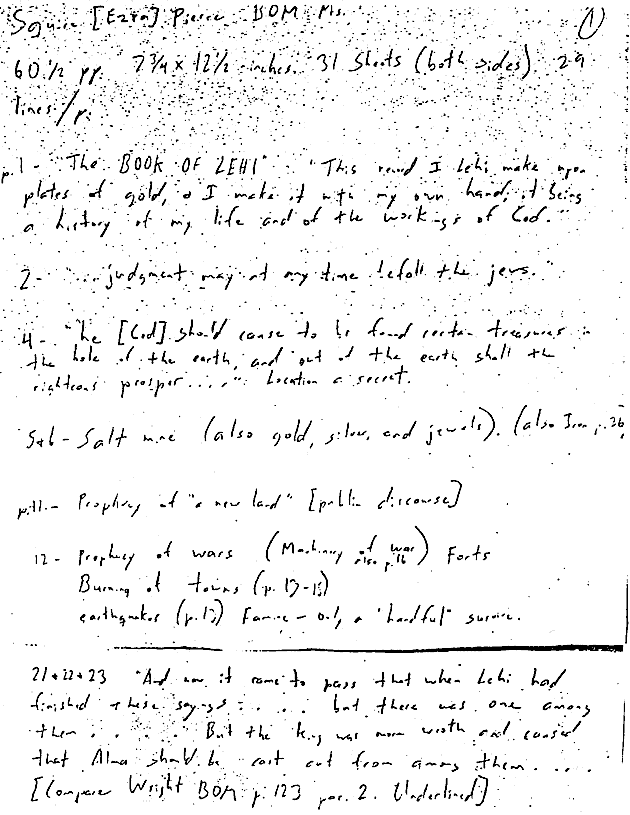
Mark Hofmann’s notes From the Book of Lehi
Mr. Hofmann had told us that the manuscript told of a mine Lehi had outside Jerusalem which contained many valuable treasures. Hofmann’s note concerning page 4 of the manuscript seems to agree with the information he gave us:
4- “he [God] should cause to be found certa[i]n treasures in the hole of the earth, and out of the earth shall the righteous prosper. . . .” Location a secret.
Mark Hofmann originally represented to Brent Ashworth that the manuscript was genuine but later told him that it was a forgery. (Since Mr. Hofmann mentioned the “Wright” edition of the Book of Mormon in the notes he gave to Mr. Ashworth, we must presume that Ashworth obtained them after Hofmann began claiming that the manuscript was a forgery.) Mr. Ashworth realized that even if the manuscript were a 19th century forgery, as Hofmann maintained, it would be a unique forgery which would be of some value. He offered Mr. Hofmann $10,000 for the forged manuscript. Although Hofmann showed him evidence that he had traveled to Bakersfield, he never produced it. Consequently, Mr. Ashworth did not lose the money.
When we discussed the manuscript with Mr. Hofmann, we suggested that it would be an important forgery and that it should be obtained. He replied that the Mormon Church was also trying to obtain it but the church would not pay the amount of money the woman in Bakersfield was asking.
While the handwritten notes Mr. Hofmann made concerning “The BOOK OF LEHI” certainly seem to show that he was working on some type of forgery of the 116 missing pages, they also raise many questions. For instance, was the manuscript ever actually penned or are the handwritten notes extracts of something which only existed in Hofmann’s mind? Why did Hofmann first claim that the manuscript was genuine and then switch to saying it was a 19th century forgery? Could he have made a mistake in the manuscript which someone informed him about that caused him to abort the project? Is it possible that the manuscript was completed and secretly sold and that the story that it was a forgery was only a means of quieting publicity about the sale? Another theory might be that Mr. Hofmann was merely trying to impress the Mormon leaders that he was a great document detective who was only seeking the truth. By claiming that he had detected forgery in a copy of the 116 pages he had found and showing how he had pinned the crime down to someone who possessed a “Wright” edition of the Book of Mormon, Mr. Hofmann could have really impressed church officials with his honesty and skill. This would have thrown them off guard, and when he showed up with a sophisticated forgery of the 116 pages they might have become easy targets for his scheme.
When we began to consider the possibility that the Book of Lehi in Bakersfield might be nothing but a figment of Hofmann’s imagination, we realized that if he ever did create the 116 missing pages and used any quotations from the Book of Nephi, he would probably take into consideration readings obtained from the original manuscript pages of the Book of Mormon. Since changes were made in the text between the manuscript and the first printed version and even more changes were made in later editions, it would be very wise to consult the original manuscripts before making any quotations. From information we have been able to obtain, it appears that Mark Hofmann did, in fact, have a great deal of interest in the original manuscripts of the Book of Nephi and would therefore be in a good position to know how to forge the Book of Lehi so that it would be believable. If a manuscript came forth which purported to be the lost 116 pages of the Book of Mormon and it contained portions similar to the printed Book of Nephi, a comparison of these portions with the original manuscripts would become very important. If the long-lost manuscript strictly followed the printed version, it might be declared a forgery. If, on the other hand, it contained peculiarities found only in the original manuscripts, this would probably be interpreted as evidence for its authenticity. Hofmann’s earlier work in disproving the manuscript which used quotations from the “Wright” edition could even suggest the idea of making such a comparison with the original manuscripts.
That Mark Hofmann was planning a very sophisticated version of the lost 116 pages seems to be supported by a number of things. To begin with, in 1982 he claimed to find a letter written by Joseph Smith’s mother. This is the only document accepted by the church which reveals anything concerning the contents of the missing pages of the Book of Mormon manuscript. At about the same time, Mr. Hofmann began to discover documents relating to Joseph Smith’s scribe, Martin Harris. This is important because Harris would have been the scribe for most of the 116 missing pages, and up until the time Mark Hofmann came on the scene, no known samples of his writing were available. There were only a few signatures.
At first Hofmann only brought forth a letter which was signed by Martin Harris. The text of the letter was supposed to be in the hand of his son. Then came the Grandin contract which the Mormon Church obtained for $25,000. This document also contained only a signature purported to be that belonging to Martin Harris. Finally, in 1983 the Salamander letter came forth. This letter had over 600 words which were supposed to be penned by Harris himself. With the authentication of Harris’ handwriting in the Salamander letter, the stage was well prepared for the ultimate discovery—the Book of Lehi.
It is claimed that investigators have in their possession a Book of Mormon in which every word has been given a number. This would be a massive project because the Book of Mormon is supposed to contain over 269,000 words! It has been speculated that this project might be tied to about 30 file drawers of note cards on the Book of Mormon and that the purpose might be to imitate Joseph Smith’s literary style in the missing 116 pages. While this would seem like a tremendous amount of work, the Book of Lehi could probably be sold to the Mormon Church for millions of dollars!
While the RLDS Church has a complete copy of the Book of Mormon manuscript (the printer’s copy), the Utah Mormon Church has only a partial copy. We now know that Mr. Hofmann was forging pages that are missing in the Mormon Church’s copy of the Book of Mormon manuscript. Brent Ashworth paid Mr. Hofmann $25,000 for just one sheet that was missing in the church’s copy of the manuscript. The Book of Lehi would obviously be worth much more than pages from known portions of the Book of Mormon, especially if the contents were controversial.
Although it seems very likely that Mark Hofmann was planning to forge the missing Book of Lehi and sell it to the Mormon Church for a large amount of money, at this point we have no evidence to show that the plan was actually carried out. We will, however, be looking for any information that points in this direction. For a more complete treatment of the Book of Lehi story we recommend our book Tracking the White Salamander, pages 104-108.
Blood Atonement
On January 24, 1987, the New York Times printed some strange information concerning the Hofmann case:
SALT LAKE CITY, Jan. 23 — Spurning his father’s appeal that he submit to execution to atone for two 1985 murders, a former Mormon missionary chose instead today to plead guilty to the crimes in return for a sentence of life imprisonment. . . . According to family members, the plea arrangement that spared his life was delayed in recent weeks by the intervention of his father, a Mormon, and other family members who said they believed that if the younger Mr. Hofmann was guilty of the murders he should be executed.
This belief is rooted in the Mormon doctrine of “blood atonement,” which holds that some crimes are so grievous that the crucifixion of Jesus had not redeemed their sins. The crimes that fall under the doctrine, promulgated principally by Brigham Young . . . include murder and adultery. . . .
In the end, church experts said, Mr. Hofmann’s father accepted the idea that his son would not have to be executed. In an effort at atonement, Mr. Hofmann, through his attorney, apologized to members of his victims’ families at a meeting Thursday.
In Tracking the White Salamander, pages 148-150, we discuss whether the doctrine of blood atonement could have any effect with regard to Hofmann’s views about taking human life. The story in the New York Times certainly adds an unexpected element to this bizarre case.
Originally appeared in:
Jerald and Sandra Tanner, “Hofmann Confesses,” Salt Lake City Messenger, no. 62, March 1987, 1-8.