
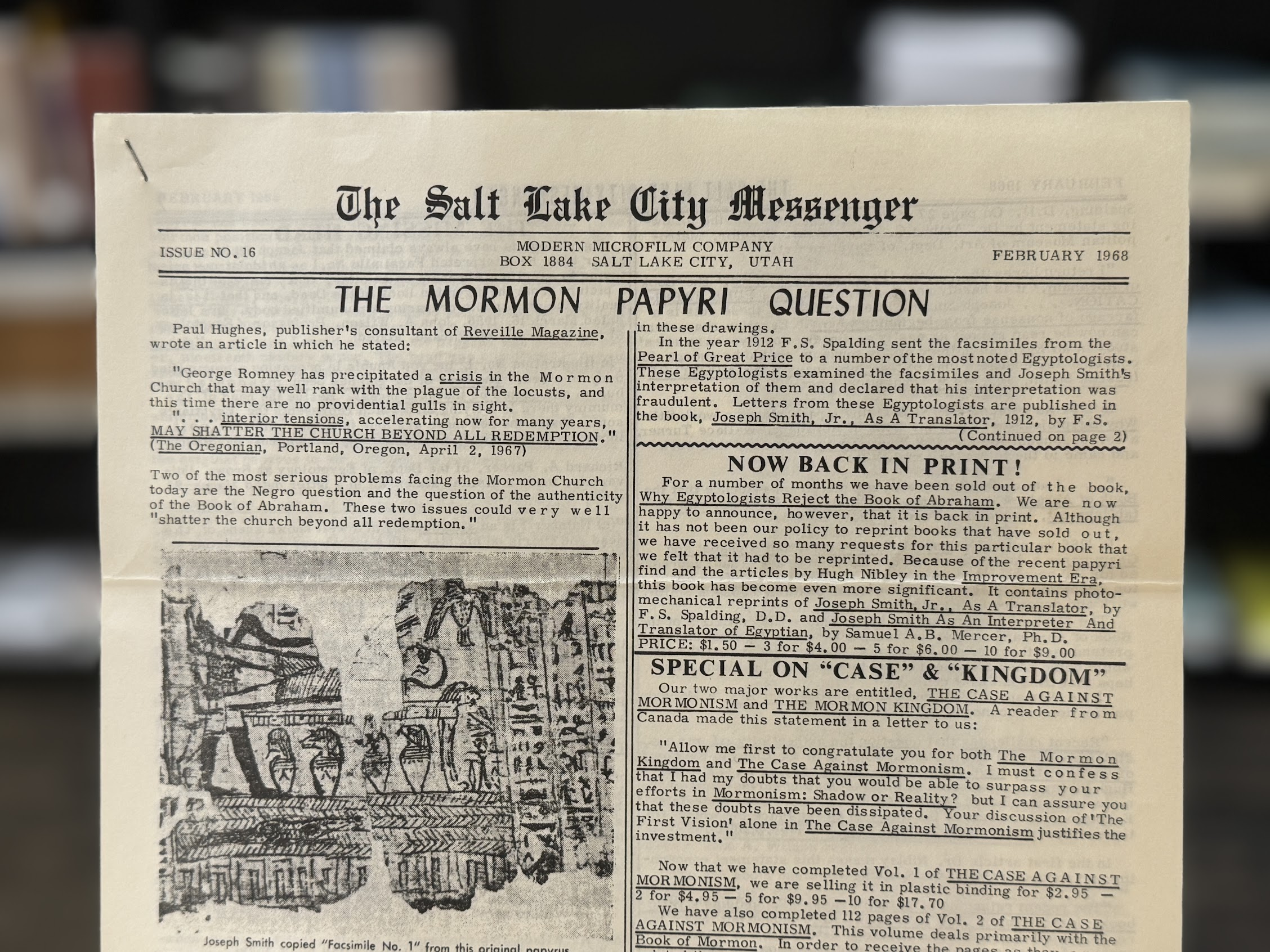
By Jerald and Sandra Tanner
Paul Hughes, publisher’s consultant of Reveille Magazine, wrote an article in which he stated:
George Romney has precipitated a crisis in the Mormon Church that may well rank with the plague of the locusts, and this time there are no providential gulls in sight.
. . . interior tensions, accelerating now for many years, may shatter the church beyond all redemption. (The Oregonian, Portland, Oregon, April 2, 1967)
Two of the most serious problems facing the Mormon Church today are the Negro question and the question of the authenticity of the Book of Abraham. These two issues could very well “shatter the church beyond all redemption.”
In the year 1835 the Mormon people purchased some Egyptian mummies and rolls of papyrus. Joseph Smith, the Mormon prophet, made this statement concerning the papyrus:
. . . I commenced the translation of some of the characters or hieroglyphics, and much to our joy found that one of the rolls contained the writings of Abraham, another the writings of Joseph of Egypt, etc.,— a more full account of which will appear in its place, as I proceed to examine or unfold them. Truly we can say, the Lord is beginning to reveal the abundance of peace and truth. (History of the Church, vol. 2, page 236)
[Bold in quotations is added for emphasis and does not appear in originals.]
The Book of Abraham was published in 1842 and is now found as a part of the Pearl of Great Price (one of the four standard works of the Mormon Church).
For a long period of time the Mormon leaders claimed that the original papyri were burned in the Chicago fire. On November 27, 1967, however, the Deseret News announced:
NEW YORK — A collection of papyrus manuscripts, long believed to have been destroyed in the Chicago fire of 1871, was presented to The Church of Jesus Christ of Latter-day Saints here Monday by the Metropolitan Museum of Art.
Included in the papyri is a manuscript identified as the original document from which Joseph Smith had copied the drawing which he called “Facsimile No. 1” and published with the Book of Abraham. (Deseret News, November 27, 1967, page 1)
Even though the papyri were lost for a number of years, Joseph Smith included three drawing in his Book of Abraham and also gave a translation of much of the material which appeared in these drawings.
In the year 1912 F. S. Spalding sent the facsimiles from the Pearl of Great Price to a number of the most noted Egyptologists. These Egyptologists examined the facsimiles and Joseph Smith’s interpretation of them and declared that his interpretation was fraudulent. Letters from these Egyptologists are published in the book, Joseph Smith, Jr., as a Translator, 1912, by F. S. Spalding, D.D. On page 27 of this pamphlet we find the following statement by Dr. Arthur C. Mace, Asst. Curator, Metropolitan Museum of Art, Dept. of Egyptian Art:
I return herewith, . . . the Pearl of Great Price. The “Book of Abraham,” it is hardly necessary to say, is a pure fabrication. . . . Joseph Smith’s interpretation of these cuts is a farrago of nonsense from beginning to end. Egyptian characters can now be read almost as easily as Greek, and five minutes’ study in an Egyptian gallery of any museum should be enough to convince any educated man of the clumsiness of the imposture. (Joseph Smith, Jr., as a Translator, page 27)
In 1964 we reprinted F. S. Spalding’s pamphlet in a work titled Why Egyptologists Reject the Book of Abraham. Wallace Turner, a correspondent for the New York Times, examined this work and came to the following conclusion:
. . . I am convinced by very simple direct evidence that the Book of Abraham is a spurious translation. (The Mormon Establishment, by Wallace Turner, 1966, page 233)
In 1966 we published Joseph Smith’s Egyptian Alphabet and Grammar—a document which the Mormon leaders had suppressed for 130 years. This work was submitted to some of the world’s top Egyptologists. These Egyptologists examined Joseph Smith’s work and denounced it as fraudulent.
The Mormon leaders have tried to ignore the criticism of the Book of Abraham and Joseph Smith’s Egyptian Alphabet and to pretend that they have no problems. We predicted that the time would come when they would have to face their problems. Perhaps that time has now come.
The January 1968 issue of the Improvement Era, a Mormon publication, announced:
Recent challenges that question the authenticity of many statements in one of the standard works of the Church, the Pearl of Great Price, have reopened an old discussion . . . Brother Hugh Nibley, . . . presents in this fascinating series some of the material that must be considered in the reappraisal of certain Egyptological aspects of the Pearl of Great Price for which the time is now ripe. (Improvement Era, January 1968, pages 18-19)
In the first article Dr. Nibley makes this statement concerning our photo-reprint of the Spalding book:
The recent reissuing of Bishop Franklin S. Spalding’s little book, Joseph Smith, Jr., as a Translator, though not meant to revive an old discussion but rather to extinguish any lingering sparks of it, is nonetheless a welcome invitation, or rather challenge, to those who take the Pearl of Great Price seriously, for long experience has shown that the Latter-day Saints only become aware of the nature and genius of their modern scripture when relentless and obstreperous criticism from the outside forces them to take a closer look at what they have, with the usual result of putting those scriptures in a much stronger position than they were before. We have all neglected the Pearl of Great Price for too long, and should be grateful to those who would now call us to account.
In this introductory study we make no excuse for poking around among old bones, since other have dug them up to daunt us; but we should warn them that if they insist on bringing up the ghosts of the dead, they may soon find themselves with more on their hands than they had bargained for. . . . it is others who have conjured up the ghostly jury to testify against the Prophet; and unless they are given satisfaction, their sponsors can spread abroad, as they did in Bishop Spalding’s day, the false report that the Scholars have spoken the final word and “completely demolished” (that was their expression) for all time the Pearl of Great Price and its author’s claim to revelation. (Improvement Era, January, 1968, pages 18-19)
We have been asked if we are going to prepare an answer to Dr. Nibley’s articles. That answer is that we intend to deal at length with his accusations in a later volume of The Case Against Mormonism. In the meantime, we have prepared a pamphlet addressing claims of Dr. Nibley and other members of the church. This pamphlet is entitled The Mormon Papyri Question. In it we show that Egyptologists have not changed their minds and that the discovery of the original papyri proves beyond all doubt that Joseph Smith did not understand ancient Egyptian.
The Missing Head
Egyptologists have always claimed that Joseph Smith was in error when he interpreted Facsimile No. 1 as an idolatrous priest trying to sacrifice Abraham on the altar. They feel that this is a picture from the Egyptian Book of the Dead, and that it is in reality the god Anubis preparing a mummified body. In a letter dated March 16, 1966, John A. Wilson, Professor of Egyptology at the University of Chicago, stated:
In illustration No. 1 the god Anubis is preparing a mummified body on a bed. The head of the god has been miscopied as human and should be that of a jackal. Beside the head of the mummy there is a flying bird which represents the Egyptian’s soul. Under the bed there are four jars into which the soft inner parts of the body were placed by the ancient Egyptians.

Joseph Smith copied “Facsimile No. 1” from this original papyrus.
Richard A. Parker, of the Dept. of Egyptology at Brown University, made a similar statement in a letter dated March 22, 1966:
(c) Number 1 is an altered copy of a well known scene of the dear god Osiris on his bier with a jackal-god Anubis acting as his embalmer. The four jars beneath the couch are four canopic jars with the heads of a human, baboon, jackal and falcon. The bird over Osiris is a ba or soul-bird. There are many variations of this scene in Egyptian monuments.

Canopic Jars
After the papyri were turned over to the Mormon Church by the Metropolitan Museum, Marvin Cowan sent pictures from the Deseret News to these same Egyptologists and asked if the photographs of the original papyri would cause them to change their opinion. In a letter dated January 5, 1968, John A. Wilson, Prof. of Egyptology at the University of Chicago, stated:
. . . as far as I am concerned I see pieces of two or possible three different papyri and every one of them looks like a traditional Book of the Dead.
Mr. Cowan asked Dr. Parker these questions concerning the papyrus Joseph Smith reproduced as Facsimile No. 1 in the Book of Abraham:
- On page seven of the enclosed article is a picture of the papyrus from which Joseph Smith drew facsimile #1. (a) Would you still say this is the god Anubis preparing a mummified body? (b) Do you see anything in the picture that would change what you previously told me?
In a letter dated January 9, 1968, Dr. Parker replied:
1. (a) Yes.
(b) No
John A. Wilson also continued to maintain that the picture showed “Anubis and the corpse” (Letter dated January 5, 1968).
Thus we see that the Egyptologists have not changed their opinions regarding this matter.
A century ago the French Egyptologist Theodule Deveria claimed that the Mormons had altered the scene shown as Facsimile No. 1 in the Book of Abraham. In 1912 Dr. Albert M. Lythgoe, head of the Department of Egyptian Art of the Metropolitan Museum, made a similar charge:
Dr. Lythgoe took up some of the slight discrepancies in the Mormon pictures from the Egyptian originals. He expressed the wish that he might see the original papyrus that the Prophet Smith translated or a photograph of it, instead of drawings made from it. In the first of the Mormon figures the god Anubis, bending over the mummy, was shown with a human and a strangely un-Egyptian head, instead of the jackal’s head usual to such a scene. And a knife had been drawn into the god’s hand. (New York Times, Magazine Sect., December 29, 1912)
Samuel A. B. Mercer stated:
It has, indeed, been questioned whether the head on figure 3 is genuine. A question has also been raised as to the genuineness of the knife in the hand. These questions are quite legitimate in the light of our knowledge of Egyptian art. (The Utah Survey, vol. 1, no. 1 September, 1913, pages 18-19)
In 1966 the Egyptologist John A. Wilson and Richard A. Parker still maintained that the scene found in Facsimile No. 1 had been altered.
R. C. Webb (whose real name was J. C. Homans) wrote in defense of the Mormon position. At the time he wrote his book, the original papyrus from which Facsimile No. 1 was drawn was not available. Therefore, he was able to criticize the Egyptologists for claiming that alterations had been made. Now that the papyrus has been located, the entire picture has changed. The Mormon position has been considerably weakened because the portions of the papyrus which have been in question—i.e., the parts that would have contained the head of Anubis and the knife—are missing! (See photograph on front page, taken from the Deseret News, November 27, 1967)
Dr. Aziz S. Atiya, the man credited with finding the Mormon papyri at the Metropolitan Museum of Art, stated that “the head had fallen off, and I could see that the papyrus was stuck on paper, nineteenth century paper. The head was completed in pencil, apparently by Joseph Smith, . . .” (Improvement Era, January 1968, page 13).
As we have shown, the Egyptologist John A. Wilson made this statement to Marvin Cowan in 1966: “The head of the god has been miscopied as human and should be that of a jackal” (Letter dated March 16, 1966). When Mr. Cowan sent the photograph of the original papyrus to Mr. Wilson, he replied:
Finally, you want to know about the embalming scene and I am comforted to see that the standing figure has no head. I am sure that it never had a human head, as all of these illustrations show an animal head. In Ryerson, Pl. XLVIII, the vignette for B.D. 151 shows the jackal-god Anubis bending over a couch, with his hands on a recumbent human figure. (Letter from John A. Wilson, dated January 5, 1968)
Book of the Dead
In a letter to Grant Heward, I. E. S. Edwards, Keeper of the Department of Egyptian Antiquities at the British Museum, made this statement concerning the Mormon papyri:
It is not my intention to belittle the gift of the Metropolitan but it should be remembered that this papyrus has really no antiquarian value. Any Book of the Dead of so late a date is corrupt and there is no need to try to solve the corruptions because earlier texts lacking many of the errors exist. (Letter dated December 20, 1967)
Evidently the Mormon leaders are now willing to concede that part of the papyri belong to the Egyptian Book of the Dead. On December 2, 1967, the L.D.S. Church Section of the Deseret News carried this statement:
The other papyri in the gift include conventional hieroglyphic and hieratic Egyptian funerary texts. Such papyri, including the Book of the Dead, wer[e] commonly buried with Egyptian mummies. (Deseret News, Church Sec., December 2, 1967, page 7)
Now that the Mormon leaders have admitted that at least part of the papyri are from the Egyptian Book of the Dead, they have placed themselves in a very precarious position. One of the drawings on the papyri was previously identified by the Mormons as part of the “Book of Joseph.” This book was supposed to have been written by Joseph in Egypt thousands of years ago. Below is a photograph of this portion as it appeared in the Deseret News, November 27, 1967.

Notice that the snake appears to be standing on legs. This portion is very important, for Oliver Cowdery, one of the three witnesses to the Book of Mormon, claimed that this drawing appeared in the “Book of Joseph.” In a letter published in the Messenger and Advocate (a Mormon publication) in 1835, Oliver Cowdery stated:
Upon the subject of the Egyptian records, or rather the writings of Abraham and Joseph, . . .
The language in which this record is written is very comprehensive, . . . The serpent, represented as walking, or formed in a manner to be able to walk, standing in front of, and near a female figure, is to me, one of the greatest representations I have ever seen upon paper, or a writing substance; . . . Enoch’s Pillar, as mentioned by Josephus, is upon the same roll. . . . The inner end of the same roll, (Joseph’s record,) presents a representation of the judgement: . . . (Messenger and Advocate, vol. 2, pages 234 and 236)
The statements by the early leaders of the Mormon Church place the present-day leaders in a very difficult situation. If they continue to maintain that this drawing is part of the “Book of Joseph,” they will be expected to furnish proof that it was written by the Israelites. Also, a translation of the Egyptian writing next to the drawing must relate to the creation or the early history of man rather than to Egyptian funerary texts. If, on the other hand, the Mormon leaders admit that it is from the Egyptian Book of the Dead, they will cast a shadow of doubt on Joseph Smith’s work.
In a letter to John A. Wilson, Professor of Egyptology at the University of Chicago, Marvin Cowan asked this question: “2. Mormon sources claim that the papyrus showing a snake walking on two legs toward a man is the ‘Book of Joseph’! Do you agree?” John A. Wilson replied:
You ask about one of the illustrations which shows a walking snake. It is just above three other illustrations all of which occur in regular order in late Books of the Dead. Papyrus Ryerson (about 500-200 B.C.) and Papyrus Milbank (about 350-100 B.C.) both in the Oriental Institute, published by T. George Allen, (“The Egyptian Book of the Dead,” Chicago, 1960), with the texts here noted on Plates XXIV-XXV and LXVIII.
In each papyrus, vignette of a man with a stick, along with a snake walking on two legs—vignette for Book of the Dead, Chapter 72.
In each papyrus, next vignette in order shows a man with a stick, facing a column—vignette for B.D. 73.
In Ryerson only, next vignette in order shows a man with a stick—vignette for B.D. 74.
In each papyrus, next vignette shows a bird with a sceptre projecting from its back—vignette for B.D. 75. (Letter from John A. Wilson to Marvin Cowan, dated January 5, 1968)
Thus we see that the Mormon leaders are confronted with a serious problem. To claim that it is the writings of Joseph is to challenge the science of Egyptology, but to admit that it isn’t amounts to discrediting Joseph Smith’s work.
Originally appeared in: